Agentic Analytics vs Traditional BI Tools: Power BI, Tableau, Looker in the Age of Autonomous AI
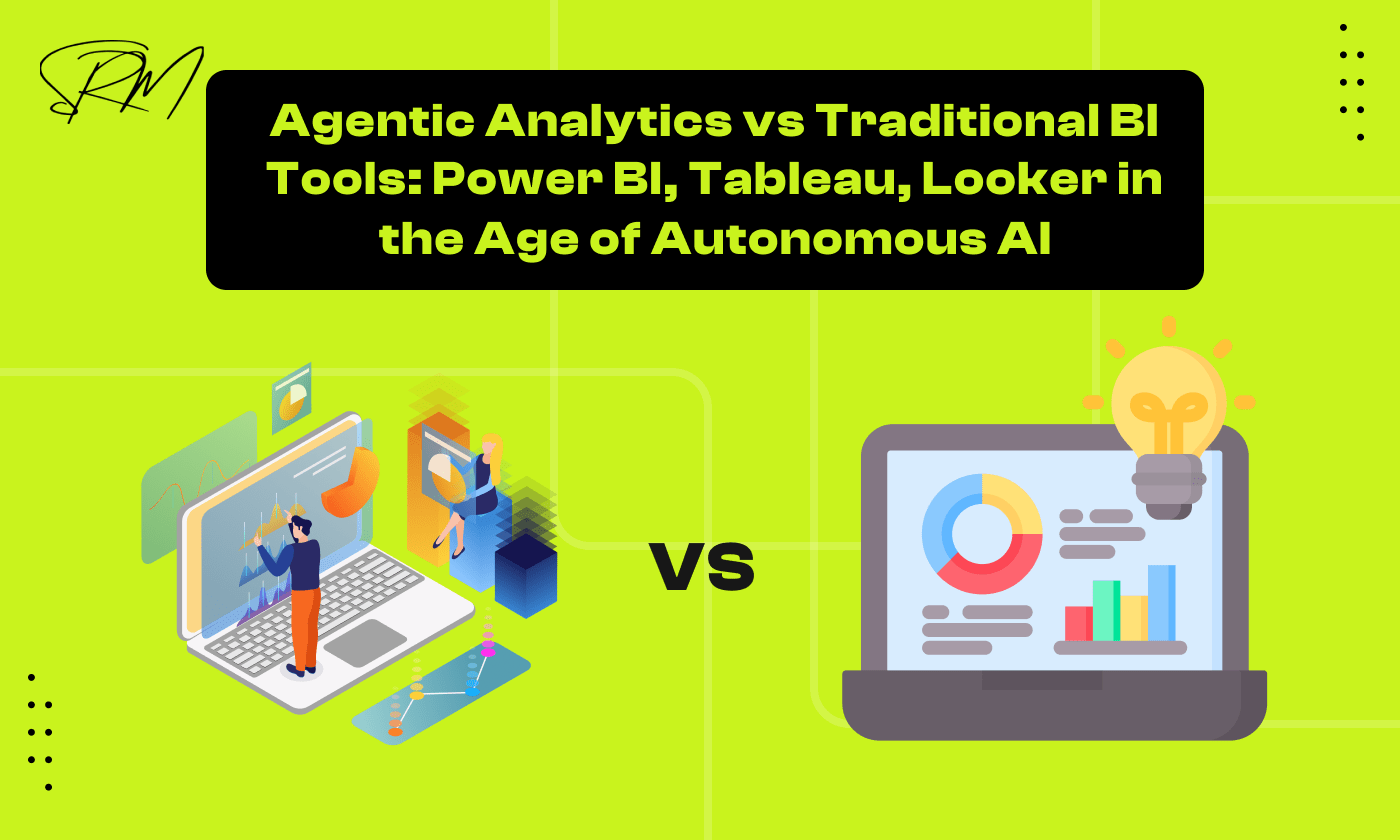
Business intelligence is no longer limited to dashboards, filters, and static reports. For years, tools like Power BI, Tableau, and Looker have helped organizations visualize data and track performance metrics. But in 2026, analytics is entering a new phase where systems do more than display insights. They act on them. This shift is driven by autonomous AI agents capable of reasoning, querying, monitoring, and even making recommendations without constant human input.
The rise of Agentic Analytics marks a fundamental transformation in how organizations interact with data. Instead of manually exploring dashboards or building reports, businesses are beginning to rely on AI systems that proactively detect anomalies, optimize KPIs, generate forecasts, and trigger decisions. Powered by large language models, retrieval systems, and multi agent architectures, these platforms move analytics from reactive reporting to autonomous intelligence.
Table of Contents
The Shift from Dashboards to Autonomous Analytics
For more than a decade, dashboards have been the foundation of business intelligence. Organizations relied on visual reports to monitor KPIs, track performance, and identify trends. Tools like Power BI, Tableau, and Looker made it easier to transform raw data into interactive charts and executive summaries. But dashboards are fundamentally reactive. They show what happened, not what should happen next.
In today’s fast moving digital economy, businesses cannot afford to wait for analysts to manually explore reports. Decision cycles are shrinking. Markets change in real time. Customer behavior shifts overnight. Static dashboards, no matter how advanced, require human interpretation before action can be taken. This dependency creates delays between insight and execution.
Autonomous analytics changes this dynamic. Instead of simply displaying data, AI driven systems can continuously monitor metrics, detect anomalies, generate explanations, and recommend next steps. The shift is not just technological. It represents a move from descriptive analytics toward intelligent, action oriented systems capable of assisting or even initiating decisions.
Why Traditional BI Is Being Challenged
Traditional BI tools like Power BI, Tableau, and Looker are powerful for visualization and structured reporting. However, they were designed for a time when data volumes were smaller and decision cycles were slower.
As businesses become more data intensive and real time oriented, several limitations are becoming visible:
- Manual dashboard creation requires time, technical skill, and ongoing maintenance
- Analysts must interpret patterns before executives can act
- Static reports may miss emerging anomalies or unexpected trends
- Insight generation does not scale easily with growing datasets
- Real time automation is limited without additional AI layers
Because of these challenges, organizations are exploring more adaptive and intelligent systems that reduce manual effort and accelerate decision making.
The Rise of Autonomous AI in Analytics
Autonomous AI introduces a new approach where intelligent agents interact with data, systems, and users. Instead of waiting for someone to analyze a report, these systems continuously evaluate information and provide contextual insights.
Agentic analytics platforms are powered by technologies such as large language models, retrieval systems, and multi agent frameworks. These capabilities allow systems to reason over data and generate meaningful outputs.
Core capabilities of autonomous AI in analytics include:
- Natural language interaction for asking complex data questions
- Automatic anomaly detection and alert generation
- Predictive modeling and scenario forecasting
- Continuous KPI monitoring without manual tracking
- Workflow automation triggered by data insights
- Context aware recommendations based on historical patterns
This rise of autonomous AI marks the beginning of decision intelligence systems that not only inform users but actively support strategic execution.
Understanding Traditional BI Tools
Traditional Business Intelligence tools were built to help organizations make sense of structured data. Long before autonomous AI entered the conversation, BI platforms transformed spreadsheets, databases, and enterprise systems into visual dashboards that executives could actually understand.
At their core, BI tools act as a bridge between raw data and business decisions. They organize information into models, apply logic through calculated metrics, and present the results in interactive reports. Instead of scanning rows of numbers, stakeholders can see trends, comparisons, and performance indicators in a visual format.
This model has powered modern enterprises for years. Finance teams monitor revenue trends. Marketing teams track campaign performance. Operations leaders evaluate supply chain efficiency. Traditional BI tools made data accessible, structured, and actionable within clearly defined boundaries.
How Power BI, Tableau, and Looker Work
Modern BI platforms like Power BI, Tableau, and Looker are built around a structured analytics pipeline. While their interfaces and ecosystems differ, they follow a common logic: connect data, model it, visualize it, and allow users to explore insights through interactive dashboards. This workflow ensures that decision makers can move from raw information to clear, visual understanding without directly interacting with databases.
At a high level, these tools transform complex datasets into organized reporting layers. Data is first integrated from multiple systems, then shaped into relationships and calculated metrics, and finally presented through dashboards that support filtering, drill downs, and comparison analysis. Although the experience feels interactive and dynamic, the intelligence behind it depends on how well analysts design the underlying data model.
Power BI
Power BI, developed by Microsoft, is widely used in enterprise environments due to its strong integration with tools like Excel, Azure, and Dynamics 365. It allows users to connect to hundreds of data sources, perform data transformation using Power Query, and build structured models with DAX calculations.
Its strength lies in enterprise reporting, scalability, and tight ecosystem alignment. Organizations already using Microsoft infrastructure often prefer Power BI for seamless deployment and governance control.
Tableau
Tableau is known for its powerful visualization engine and intuitive drag and drop interface. It enables users to explore data visually without heavy coding, making it popular among analysts and business users who value storytelling through data.
Tableau focuses heavily on interactive dashboards, advanced charting capabilities, and real time exploration. It excels in uncovering patterns and trends visually, which makes it particularly strong in exploratory analytics.
Looker
Looker, part of Google Cloud, is built around a semantic modeling layer called LookML. Instead of relying solely on dashboard level calculations, Looker defines business logic at the modeling layer, ensuring consistency across reports.
It is cloud native and designed to work closely with modern data warehouses like BigQuery. Looker emphasizes governed data modeling and scalable analytics for organizations operating in cloud first environments.
Despite their differences, all three platforms share a foundational approach. They depend on predefined data structures and user initiated exploration rather than autonomous reasoning. This is where the contrast with Agentic Analytics becomes significant.
Core Strengths of Dashboard Based Analytics
The continued dominance of traditional BI tools is not accidental. They offer reliability, structure, and governance that enterprises depend on for consistent and secure decision making.
- Clarity and a Single Source of Truth: Well designed dashboards create alignment across departments by standardizing KPIs and definitions. Leadership teams can review the same metrics without confusion or conflicting interpretations. This consistency reduces internal debate and supports faster executive decisions.
- Strong Governance and Compliance Controls: Traditional BI platforms provide structured access permissions, role based visibility, and data lineage tracking. Centralized data modeling ensures that metrics are calculated consistently across reports. For regulated industries such as finance and healthcare, this governance framework is essential for compliance and audit readiness.
- Scalable Reporting Across the Organization: Dashboard based systems allow organizations to deploy standardized reports across regions, departments, and business units. This scalability ensures operational consistency and makes it easier to monitor performance at both local and global levels.
- Excellence in Descriptive Analytics: Traditional BI tools are highly effective at answering fundamental business questions such as what happened, when it happened, and how results compare to targets. They provide structured visibility into historical performance, which remains a critical foundation for strategic planning and accountability.
Key Limitations in the AI Era
However, as artificial intelligence advances, the limitations of dashboard based analytics are becoming more visible.
Traditional BI assumes that users know what they are looking for. Reports are built around predefined KPIs and structured queries. If a new risk emerges outside those predefined views, it may go unnoticed until someone manually investigates.
Another limitation is the reactive nature of dashboards. They present historical or near real time data, but they rarely provide proactive recommendations. An executive might see that revenue declined, but the system does not automatically explain why or suggest corrective actions without additional analysis.
There is also the challenge of scale and complexity. Modern enterprises generate massive volumes of structured and unstructured data. Text, voice, and behavioral signals are harder to integrate into conventional BI workflows. As datasets grow more complex, manual modeling and dashboard maintenance become increasingly resource intensive.
In the age of autonomous AI, organizations are beginning to expect more than visualization. They want systems that continuously monitor performance, detect anomalies, generate explanations, and recommend next steps. This expectation is precisely what has fueled the emergence of Agentic Analytics.
What Is Agentic Analytics
Agentic Analytics represents the next evolution of business intelligence, where analytics systems move beyond visualization and begin to act with a degree of autonomy. Instead of waiting for users to explore dashboards or ask structured queries, agentic systems proactively monitor data, interpret patterns, generate insights, and in some cases recommend or trigger actions.
This approach is built on intelligent agents powered by large language models, reasoning frameworks, and tool integration capabilities. These agents can interact with databases, APIs, and workflows much like a human analyst would, but at machine speed and scale. The goal is not just to describe what happened, but to continuously analyze what is happening and determine what should happen next.
Definition and Core Principles
Agentic Analytics can be defined as an AI driven analytics framework where autonomous or semi autonomous agents perform data analysis, insight generation, and decision support with minimal manual intervention.
Its core principles include:
- Autonomy: Systems can initiate analysis without waiting for explicit user prompts. They continuously monitor metrics and identify meaningful changes.
- Reasoning Over Data: Instead of only aggregating numbers, agentic systems interpret context, compare scenarios, and generate explanations.
- Proactive Insight Generation: Rather than reacting to queries, the system surfaces anomalies, risks, and opportunities automatically.
- Tool Integration: Agents can connect to external systems such as CRMs, marketing platforms, financial tools, and operational software to gather or act on data.
- Continuous Learning and Adaptation: With feedback loops and memory layers, the system improves recommendations over time.
These principles shift analytics from static reporting to dynamic decision intelligence.
AI Agents vs AI Copilots
The terms AI agent and AI copilot are often used in similar contexts, but they represent fundamentally different levels of autonomy within analytics systems. Understanding this distinction is critical when evaluating modern BI platforms and emerging agentic architectures.
An AI copilot functions as an intelligent assistant. It enhances user productivity by responding to prompts, generating summaries, recommending visualizations, or suggesting calculations. However, it remains reactive. Every action begins with a human request, and the system operates within clearly defined boundaries. Most AI features currently embedded in BI tools fall into this category, offering assistance rather than independent execution.
An AI agent, by contrast, is designed to act with a higher degree of independence. Instead of waiting for instructions, it can continuously monitor data streams, detect anomalies, initiate analysis, and recommend actions based on predefined objectives. In more advanced systems, agents can even coordinate with other agents or trigger automated workflows. The defining difference is initiative. Copilots respond. Agents initiate.
| Feature | AI Copilot | AI Agent |
| Level of Autonomy | Reactive assistance | Proactive and semi autonomous |
| Initiative | Waits for user prompts | Can initiate analysis independently |
| KPI Monitoring | On demand | Continuous monitoring |
| Insight Generation | Based on user queries | Automatically detects patterns and anomalies |
| Workflow Execution | Suggests actions | Can trigger predefined actions |
| Role in Decision Making | Supports human decisions | Participates in and influences decisions |
How Autonomous Analytics Systems Operate
Autonomous analytics systems typically operate through a layered architecture.
First, they integrate with structured and unstructured data sources such as databases, APIs, cloud warehouses, and event streams. This ensures real time access to business data.
Second, large language models and reasoning engines interpret the data. They translate business questions into structured queries, retrieve relevant information, and analyze patterns across multiple datasets.
Third, agent frameworks coordinate tasks. In advanced systems, multiple agents may collaborate, with one agent retrieving data, another performing statistical analysis, and another generating a business level explanation.
Finally, the system delivers outputs through conversational interfaces, automated alerts, or workflow integrations. In some implementations, the system can even execute actions such as adjusting budgets, sending notifications, or updating forecasts based on predefined rules.
By combining reasoning, automation, and integration, Agentic Analytics transforms analytics from a passive reporting function into an active intelligence layer within the enterprise.
Feature Comparison: Agentic Analytics vs Traditional BI
The difference between Agentic Analytics and Traditional BI becomes most visible when we compare their core capabilities. Traditional BI platforms were designed to organize and visualize data efficiently. Agentic systems, on the other hand, are designed to reason over data, automate analysis, and support decisions proactively.
While both approaches aim to improve business intelligence, they operate at different levels of analytical maturity. The contrast is especially clear across exploration, automation, real time responsiveness, and conversational interaction.
Data Exploration and Querying
In traditional BI tools, data exploration is largely user driven. Analysts or business users interact with dashboards, apply filters, drill down into metrics, and manually adjust views to uncover patterns. Queries are typically structured and depend on predefined data models. If a metric was not modeled in advance, deeper analysis may require additional development work.
Agentic Analytics transforms this experience. Instead of relying solely on manual exploration, AI agents can translate business questions into structured queries automatically. They retrieve relevant data, compare historical patterns, and analyze cross dataset relationships without requiring users to navigate dashboards step by step.
In practical terms:
- Traditional BI responds to structured queries.
- Agentic systems generate and refine queries dynamically.
- Exploration shifts from manual navigation to AI driven reasoning.
This reduces dependency on technical expertise and accelerates insight discovery.
Automation and Insight Generation
Traditional BI excels at reporting but remains largely reactive. Insights are generated when users review dashboards or schedule reports. Alerts may exist, but they are typically rule based and limited in complexity.
Agentic Analytics introduces deeper automation. AI agents can continuously monitor performance metrics, detect anomalies, identify emerging trends, and generate contextual explanations. Instead of simply showing that a KPI changed, the system can analyze contributing factors and propose potential actions.
For example:
- A dashboard may show declining conversions.
- An agentic system can identify traffic source changes, budget shifts, or seasonal effects contributing to the decline.
This shift moves analytics from passive reporting to proactive intelligence.
Real Time Decision Support
Traditional BI tools often operate on scheduled refresh cycles. Even when near real time data is available, interpretation and decision making still depend on human review.
Agentic systems are built to operate continuously. They can monitor live data streams, evaluate risk thresholds, and escalate critical events instantly. In advanced setups, they may trigger automated workflows such as reallocating marketing spend, flagging fraud transactions, or adjusting operational processes.
The key distinction lies in responsiveness:
- Traditional BI informs decisions.
- Agentic Analytics supports and sometimes initiates decisions.
This capability is especially valuable in fast moving environments such as finance, ecommerce, and supply chain management.
Natural Language and Conversational Analytics
Natural language querying has existed in BI tools for years, allowing users to type simple questions and receive visual responses. However, these systems often rely on predefined mappings and limited contextual understanding.
Agentic Analytics leverages large language models to enable deeper conversational interaction. Users can ask complex, multi-step questions in natural language. The system can clarify ambiguity, maintain context across conversations, and refine analysis iteratively.
For instance, a user might ask:
“Why did customer retention drop last quarter compared to the previous year?”
A traditional system might provide a chart.
An agentic system can analyze segmentation data, identify churn drivers, compare cohorts, and summarize findings in plain language.
This evolution transforms analytics from a dashboard interface into an interactive decision partner.
Enterprise Impact and Business Use Cases
The true value of Agentic Analytics becomes clear at the enterprise level. While traditional BI platforms have long supported reporting and performance tracking, agentic systems expand analytics into continuous intelligence and adaptive decision support.
For enterprises managing complex operations, large customer bases, and real time transactions, the difference is significant. Instead of reviewing dashboards after performance shifts occur, organizations can deploy AI driven systems that monitor, interpret, and recommend actions proactively. This transition reshapes how departments collaborate, how risks are managed, and how growth strategies are executed.
Below are key areas where the impact is most visible.
Marketing and Growth Analytics
Marketing teams operate in environments where performance changes rapidly. Campaign ROI, customer acquisition cost, retention metrics, and conversion rates fluctuate based on numerous variables such as seasonality, competition, and channel mix.
Traditional BI tools help marketers visualize campaign results and compare performance across channels. However, they often require manual interpretation to understand why a shift occurred.
Agentic Analytics enhances this by:
- Continuously monitoring campaign performance across platforms
- Identifying anomalies in traffic, engagement, or conversions
- Analyzing attribution patterns automatically
- Recommending budget reallocations based on performance signals
- Forecasting growth scenarios using predictive modeling
For example, if paid search conversions decline unexpectedly, an agentic system can analyze keyword performance, bidding changes, competitor trends, and landing page engagement to generate a structured explanation. This reduces analysis time and allows marketing teams to respond faster.
In growth focused organizations, this proactive capability can significantly improve agility and competitive positioning.
Finance and Risk Monitoring
In finance, speed and accuracy are critical. CFOs and risk managers rely heavily on dashboards for tracking revenue, expenses, margins, and compliance metrics. While traditional BI provides structured oversight, it may not always surface emerging risks immediately.
Agentic systems introduce continuous risk evaluation by:
- Monitoring financial transactions in real time
- Detecting unusual spending patterns or revenue anomalies
- Flagging compliance risks automatically
- Generating variance explanations between forecast and actuals
- Simulating future risk scenarios based on historical trends
For instance, instead of waiting for a monthly variance report, an autonomous analytics system can detect abnormal expense spikes and notify decision makers instantly. It can also analyze contributing factors and recommend corrective actions.
In regulated industries, combining governance controls from traditional BI with AI driven anomaly detection creates a more resilient financial intelligence framework.
Operational and Supply Chain Intelligence
Operational environments generate high volumes of data from logistics systems, inventory management platforms, manufacturing units, and distribution networks. Traditional dashboards help track delivery timelines, stock levels, and production efficiency. However, operational risks often require rapid response.
Agentic Analytics supports operational intelligence by:
- Continuously analyzing supply chain performance metrics
- Predicting potential disruptions using historical and external data
- Optimizing inventory levels based on demand forecasting
- Recommending route adjustments or supplier changes
- Triggering alerts when service levels fall below thresholds
For example, if shipment delays begin to increase in a specific region, an agentic system can analyze weather data, vendor performance, and demand fluctuations to identify the root cause. It can then suggest alternative suppliers or logistics adjustments before customer impact escalates.
This proactive layer transforms operations from reactive monitoring to adaptive optimization.
The Future of BI in the Age of Autonomous AI
The future of Business Intelligence in the age of autonomous AI is about moving beyond static dashboards toward continuous, intelligent decision support. Traditional BI tools helped organizations understand what happened through reports and KPIs. That foundation remains important, but modern businesses now need systems that actively monitor data and surface insights without waiting for manual queries.
Autonomous AI brings proactive analytics into the picture. Instead of relying only on user driven exploration, next generation BI platforms can detect anomalies, identify trends, and recommend actions in real time. This shortens the gap between insight and execution, making analytics more operational and less reactive.
The focus is also shifting from descriptive reporting to predictive and prescriptive intelligence. Future BI systems will not just explain performance but forecast outcomes and suggest next steps. Combined with natural language interaction, this makes advanced analytics more accessible across teams.
At the same time, governance and transparency remain critical. As AI takes on a more active role, organizations will demand clear audit trails, explainable models, and strong data controls.
Business Intelligence is evolving into Decision Intelligence. The competitive advantage will belong to companies that build systems capable of continuously learning, guiding, and improving decisions in real time.
February 23, 2026
The 2026 Data Revolution: From Passive Dashboards to...
February 23, 2026