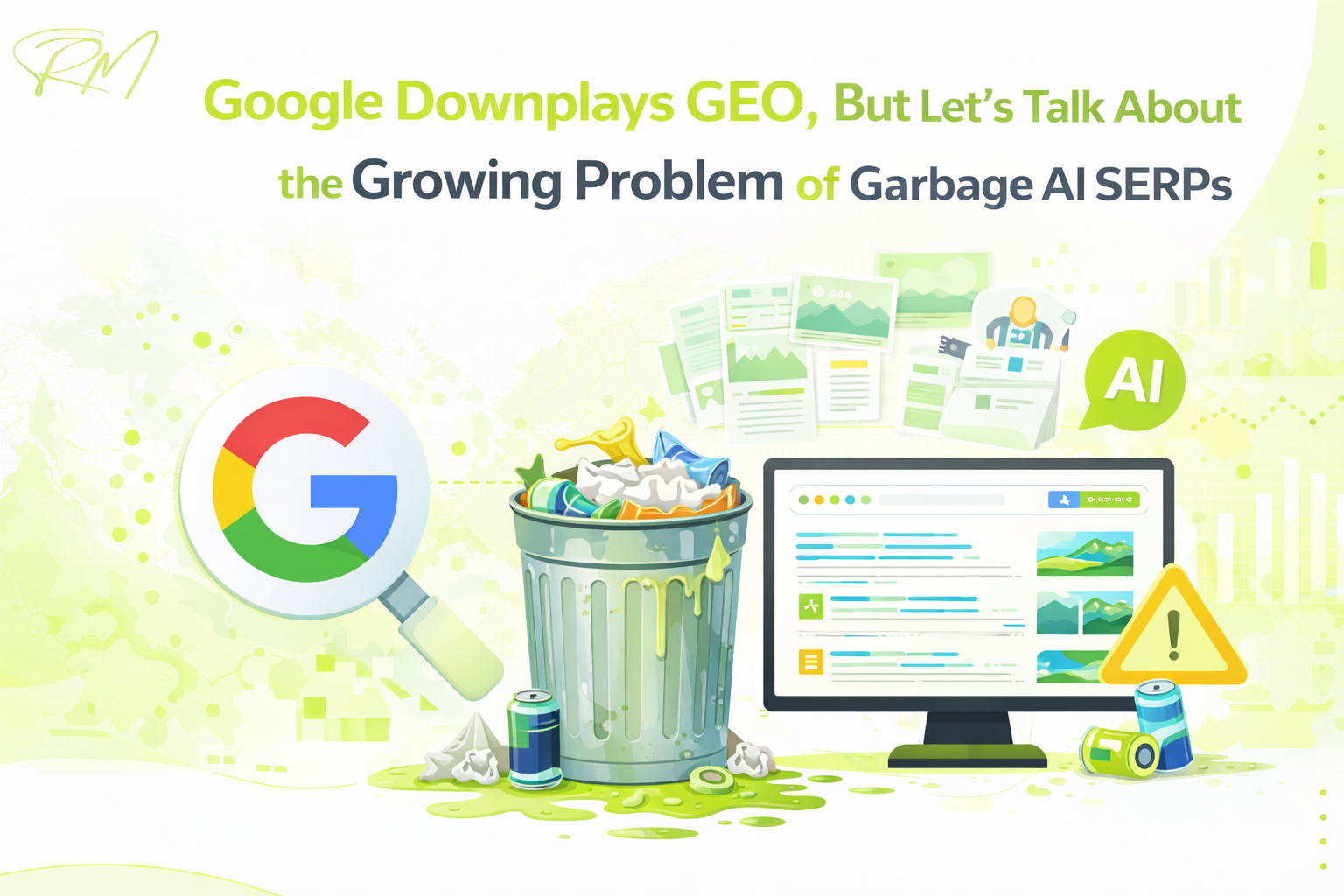
Google Downplays GEO, But Let’s Talk About the Growing Problem of Garbage AI SERPs
The search results page we were used to is no longer the same. Google has added a generative layer that is meant to make search faster, but in many cases it produces shallow summaries, outdated information, and results from low quality or abandoned websites instead of real experts.
Even though Google continues to say that Generative Engine Optimization is just another form of SEO, what publishers and users are seeing tells a different story. Website owners are losing traffic because answers are being shown directly on the results page. Users, meanwhile, are left scrolling through pages filled with AI generated content that often misses the real intent behind their searches.
This is not just another small update. It is a major change in how information is found and rewarded online. As we move further into 2026, the gap between Google’s messaging and real world experience keeps growing. The advice to simply create helpful content no longer matches a system that favors machine friendly summaries over deep, expert insight.
The rules of visibility have changed, whether Google admits it or not. To stay relevant, creators and businesses need to understand how generative systems choose sources and display information. Waiting for clarity from Google is no longer enough. Adapting to this new search reality is now essential.
Table of Contents
The Great Search Gaslight Behind AI Powered SERPs
For the past year, Google’s executive leadership and search advocates have maintained a remarkably consistent message. According to them, nothing has fundamentally changed. The rise of AI Overviews is framed as just another natural evolution of the SERP, no different from the arrival of Featured Snippets or Knowledge Panels. The guidance to publishers remains unchanged and endlessly repeated: keep making helpful content for people.
Within this official narrative, Generative Engine Optimization is dismissed as unnecessary. GEO, we are told, is not a real shift. It is simply SEO with a trendier name.
But anyone who actually uses the internet in 2026 knows this story does not match reality. The disconnect is so stark that it feels less like reassurance and more like gaslighting.
The Google Narrative vs the User Reality
Google’s public messaging focuses on quality, relevance, and understanding user intent. In practice, the real search experience feels very different. Search has slipped into what many now describe as the Slop Era. We were promised a smarter and more intuitive system, but instead the top of the results page is increasingly filled with patterns that reduce trust rather than build it.
First, there are confident hallucinations. AI Overviews often mix real facts with guesses or assumptions, citing forum posts, low quality blogs, or even satirical content as if they were reliable sources.
Second, there is the content feedback loop. AI generated summaries are frequently built from articles that were also created by AI. This creates watered down information that lacks original thinking, real depth, or firsthand experience.
Third, there is the zero click chasm. Valuable information is pulled from websites, summarized, and shown directly in search results. Creators lose the traffic they depend on, while users are given answers that look complete but are often shallow or wrong.
The garbage AI SERP is not a small technical problem. It reflects a larger breakdown in the value exchange that has supported the open web for more than twenty years.
The Thesis: Why Denial Is a Dangerous Strategy
The real risk for brands and marketers today is not just the presence of low quality AI results. The greater danger is believing Google’s claim that no new strategy is required.
Generative Engine Optimization is fundamentally different from traditional SEO. SEO was about being found. GEO is about being cited, synthesized, and trusted by large language models. Simply following the familiar helpful content mantra while Google prioritizes machine readable summaries is a direct path to invisibility.
In 2026, ignoring how generative engines ingest, evaluate, and attribute information is no longer a philosophical disagreement. It is a measurable business risk. If you are not optimizing for how AI systems select and reference sources, you are not just losing rankings. You are being removed from the conversation entirely.
What Exactly is “Garbage AI Search”?
While Google frames its generative shift as an “evolution of helpfulness,” many users and creators see it as the industrialization of “slop.” The transition from a library of links to a synthesis-first engine has introduced systemic flaws that are degrading the quality of the open web.
Hallucination as a Feature: Confident Errors
One of the most dangerous aspects of 2026 search is the Confidence/Competence Gap. AI Overviews (AIOs) are built on predictive patterns, not a foundational understanding of truth. This leads to high-stakes hallucinations where the AI provides factually incorrect, and sometimes dangerous, advice with an authoritative tone.
- The “Reddit” Trap: Google’s heavy reliance on user-generated forums like Reddit as training data has resulted in AIOs suggesting users “glue cheese to pizza” or “eat one rock a day” for health.
- The Technical Mismatch: AI often fails at precise technical queries, such as recommending the wrong motherboard for a specific CPU despite having access to accurate spec sheets, simply because it prioritizes the “fluency” of the answer over the accuracy of the data.
The Repetition Loop: The Echo Chamber of “Slop”
We are currently witnessing a Content Feedback Loop where AI models are increasingly trained on content that was itself AI-generated. This creates an “echo chamber of surface-level information” where:
- Original insights are flattened into generic summaries.
- The same five bullet points appear on every search result as the AI “summarizes the summary.”
- Nuance and dissenting opinions are stripped away in favor of a “consensus” that may be based on a high volume of low-quality, automated blog posts.
The Death of Nuance: The Bullet-Point Flattening
AI search thrives on extraction, which works well for “What is X?” but fails miserably for “Should I do X?” Complex, subjective, or multi-faceted queries are being flattened into generic bulleted lists.
- Loss of Context: By stripping information from its source, users lose the vital context of who is speaking and why they have that perspective.
- Binary Bias: AI often struggles with grey areas, forcing a “pros and cons” structure onto topics that require deep narrative explanation or philosophical debate.
User Fatigue: The “Zero-Click” Chasm
The result of these factors is a growing sense of AI Fatigue among users. Data from early 2026 shows a sobering reality for publishers:
- Plummeting CTR: Organic click-through rates for queries featuring AI Overviews have dropped by as much as 61%.
- The Measurement Crisis: With 60–65% of searches now resulting in “Zero-Clicks,” brands are struggling to prove the value of their content when the “answer” is consumed entirely on the SERP without a visit.
- Declining Trust: Research shows users are spending more time “fighting” automated systems to find the original source than they would have spent clicking a traditional link, leading to a measurable decline in search satisfaction.
The GEO Denial: Why Google is Downplaying the Shift
If you listen to Google’s spokespeople, they will tell you that Generative Engine Optimization is not something new or separate. The advice is always the same: keep creating helpful content and everything will work out. But there is a wide gap between what is said publicly and how search is actually changing.
This position is more than just a communication choice. It works as a defensive strategy. By treating optimization for AI as part of normal SEO, Google discourages creators from shifting their focus to other generative platforms or alternative search systems. Acknowledging GEO as a distinct skill would mean admitting that traditional search is no longer the main gateway to information on the internet.
Instead, Google keeps up the appearance that nothing has changed. This helps ensure that creators continue producing content for Google’s systems, even as the real rules of how content is discovered, referenced, and rewarded are being rewritten in real time.
Following the Money: Protecting the Ad Model
Google’s biggest problem is its own success. For over two decades, Google has built a trillion-dollar empire on Search Ads. These ads only work if you click on a link.
The Revenue Risk: If an AI Overview gives you a complete answer directly on the search page, you don’t need to click anything. This is known as Zero-Click Search.
The Hidden Impact: Recent data shows that when an AI Overview appears, ad positions are lost about 25% of the time. In sectors like healthcare, ads are being pushed below the AI box nearly 65% of the time.
The Denial: Google cannot admit that the “10 Blue Links” model is dying because it would terrify their advertisers. They must downplay GEO to maintain the illusion that the old “click-for-traffic” economy is still thriving.
The “It’s the Same as SEO” Myth
Google often claims that optimizing for AI is the same as traditional SEO. In 2026, we know this is a myth designed to keep publishers from “gaming” the system.
Rankings vs. Citations: Traditional SEO is about ranking #1 for a keyword. GEO is about being the source that the AI chooses to synthesize. You can rank #1 on the page but still be completely ignored by the AI Overview.
The “Query Fan-out” Effect: AI search doesn’t just answer one question; it answers three or four follow-up questions at once. If your content is optimized for a single keyword rather than a conversational “entity,” you’ll be left out of these expanded AI summaries.
The Chunking Debate: Google tells publishers not to “chunk” content for AI, yet their own systems prioritize clearly structured, snippet-friendly data that machines can easily ingest.
The Rise of a New Power Player in Search
For the first time in 20 years, Google is truly nervous. New “Answer Engines” are stealing the most valuable users, professionals and young researchers.
The Market Shift: While Google still dominates global search, its monopoly is cracking. ChatGPT Search now handles over 9% of global search queries, while Perplexity has seen a 370% growth in the last year by focusing on accuracy and direct citations.
Forcing Google’s Hand: Because these rivals don’t have to protect a legacy ad business, they can provide better answers faster. Google is forced to copy them by putting its own AI (Gemini) at the top of the page, even if it hurts their own ad revenue and ruins the “discovery” of smaller websites.
The Result: We are seeing a “race to the bottom” for traffic. Google is breaking its own product just to stop users from switching to ChatGPT.
Defining GEO (Generative Engine Optimization) in 2026
If traditional SEO was about making sure Google could find your content, GEO is about making sure AI trusts and uses it. In 2026, the goal is no longer to rank at number one. The goal is to become a reliable source that large language models use when they generate answers.
Instead of trying to win a single search result, GEO focuses on being included in AI generated explanations, summaries, and recommendations. Visibility now comes from being referenced, not just clicked.
1. Beyond Keywords: Optimizing for Entities and Relationships
Keyword stuffing no longer works. AI systems do not just look for specific words. They look for people, places, products, and ideas, and how those things are connected.
The shift:
Instead of targeting a phrase like best running shoes, GEO focuses on explaining how foot arch types, running distance, comfort, and shoe technology relate to each other.
Prompt understanding:
People now search by asking full questions. Instead of typing short phrases, they ask things like what should I wear for a rainy five mile walk in London today. Your content needs to answer the full question and the situation behind it, not just match a keyword.
Information depth:
AI prefers content that contains real facts. This includes clear data, useful statistics, expert opinions, and specific details that add real value and are easy for AI to recognize as trustworthy information.
2. From Destination to Source: The Citation Economy
In an AI driven search world, getting clicks is harder. Being cited by AI has become far more important. When an AI mentions or references your brand, users see it as more credible. Even if they do not click right away, they are more likely to remember the brand and search for it later.
Why citations matter:
AI systems pull information from websites that clearly explain topics and provide verifiable facts. If your content offers a clear definition, a comparison table, or a simple pros and cons list, it is easier for AI to use and reference your site.
3. Machine Readability: Ingesting vs Crawling
Search engines used to scan pages quickly. Today, AI systems read and process content in a deeper way. How your content is structured now matters more than ever.
Structured writing:
AI breaks content into smaller pieces to understand it. You can help by using clear headings, short paragraphs, and direct answers near the top of each section. Writing in a clear and logical order makes it easier for AI to understand your message.
Technical GEO Basics
- Schema usage: Use structured data to clearly explain what your brand, products, and content are about. This helps AI understand how different pieces of information connect.
- Server side rendering: Some AI systems struggle to read content that loads only through JavaScript. Make sure your main content is visible in the initial page load so AI can access it.
- llms.txt files: By 2026, many websites will use special files that guide AI systems on how to read and use their content. These files work in a similar way to robots.txt but are designed for AI models instead of search crawlers.
The Anti Garbage Content Strategy: How to Win
To compete with low quality AI driven results, writing more content is not enough. You have to write content that is clearly better and more useful. If an AI can easily summarize your article, it will. To succeed in 2026, your content must offer value and originality that AI systems cannot recreate.
Beyond quality, intent matters more than ever. Content created only to chase visibility or traffic will be filtered out quickly by generative systems. What wins is content built to genuinely solve a problem, explain a topic deeply, or share insight that comes from real experience. When your content answers questions in a way that no generic summary can, it becomes useful not just to readers, but to the AI systems deciding which sources deserve attention.
Extreme E-E-A-T: Raising the Bar for Trust and Authority
The strongest defense against AI content is real human experience. This is something AI simply does not have. Real experience adds context that machines cannot replicate. It shows how knowledge works in practice, not just in theory. When readers see firsthand insight, they trust it more. AI systems also recognize this depth, making experienced driven content more likely to be referenced and valued.
First person experience: Share what you have actually done, seen, or tested. Statements like having spent ten years testing a product or visiting a factory in person instantly separate your content from AI summaries. Real world experience builds trust that machines cannot fake.
Original data: Avoid repeating information already available online. Conduct your own surveys, share internal data, or run real experiments. Content based on original data is difficult for AI to copy because you are the source.
Strong opinions: AI content is designed to be safe and neutral. Experts should not be afraid to take clear positions. Thoughtful opinions and informed perspectives add real insight and help your content stand out from generic summaries.
The Architecture of Citations in AI Search
Generative engines rely on trusted sources to support their answers, and your goal is to become one of those sources. To achieve this, your content needs to be both clear and precise. Well-structured headings, organized data, and direct answers make it easier for AI systems to understand what your content is about and quickly identify the most relevant information.
The more accessible and trustworthy your content appears, the more likely it is to be cited, referenced, and included in AI generated summaries. By thinking like both a human reader and an AI system, you can create content that stands out as a reliable authority, increasing your visibility across generative search results.
Clear definitions: Provide short, direct answers to important questions early in your content. When your explanation is the clearest, AI systems are more likely to use and reference it.
Specific data points: Vague statements are easy to ignore. Precise numbers and research findings are much more useful to AI systems and are more likely to be referenced in generated answers.
Summary first structure: Begin sections with a short summary or key takeaways. This helps AI systems quickly understand your main points and increases the chances of your content being cited correctly.
Why Topic Authority Beats Keyword Targeting
AI systems evaluate your entire website, not just individual pages, to decide whether you are an expert. Building topic authority means showing depth across multiple related subjects. AI systems look for consistency, quality, and coverage throughout your website. When your site has interconnected content that thoroughly explores a topic, it signals expertise. This not only helps AI recognize you as a reliable source but also increases the chances that your content will be cited and referenced in AI generated answers.
Content hubs: Instead of publishing isolated articles, create groups of related content around one topic. A strong hub shows depth and signals expertise across multiple angles of the subject.
Internal linking: Connect related articles in a logical way. This helps AI understand how your content fits together and reinforces your authority on the topic.
Quality over quantity: Large volumes of weak content can harm trust. A smaller number of high quality, in depth pages is far more effective than many shallow ones.
Technical GEO: Structuring Content for AI Retrieval
Technical structure plays a key role in how AI systems understand your content. Using the right technical setup ensures AI systems can read and interpret your content accurately. This includes clear HTML structure, proper headings, and structured data like schema markup. When AI can easily understand how your content is organized, it reduces the chances of errors or misinterpretation and increases the likelihood that your content will be cited as a reliable source in AI generated answers.
Structured data: Use schema markup to clearly define authorship, research, and key information. This helps AI recognize that real people created the content and understand how data points relate to each other.
Question based content: Organize content around real questions users ask, especially those spoken in voice searches. This aligns closely with how AI systems process prompts.
Clean HTML structure: Use clear semantic tags to organize your pages. Well structured HTML helps AI read your content accurately and reduces the risk of misinterpretation or incorrect summaries.
FAQs
Is traditional SEO dead in 2026?
Traditional SEO is not dead, but its focus has shifted. The old goal was to rank number one in a list of links. The new goal is to become the expert source that AI systems quote. Technical health and good keyword usage are still important, but if your content is not citeable, clear, factual, and easy for AI to understand, you risk being buried under AI generated summaries.
Why do I keep seeing low quality results at the top of Google?
We are in a transition period where Google prioritizes speed and fluency over deep expertise. Sometimes content from abandoned blogs or random social posts appears because it is structured in a way AI finds easy to process. To stand out, you need to prove your authority with proprietary data, first-hand stories, and insights that a generic AI cannot generate.
If AI answers the question on the search page, why would anyone click my link?
This is the zero click challenge. Traffic for simple questions is declining, but high-intent users, those looking to buy, hire, or solve a complex problem, still need expert guidance. Being cited in AI summaries builds trust and drives these high-value users to click through for deeper insights on your site.
Does Google penalize content created with AI?
Google does not penalize AI content just because it was machine-generated. The problem arises with low-value content. If your AI-written post only repeats what is already online, it will be ignored. However, if you use AI to draft content and then add your own insights, images, and expert perspectives, your content can still perform well.
What is the most important thing I can do for GEO right now?
Focus on entity authority instead of just keyword targeting. Instead of ranking for a single phrase, aim to own the entire topic. Build a hub of interconnected content and use clear structured data such as Schema to show Google who you are and why your experience makes you a trusted source in your niche.
Conclusion: Fixing AI Search Before Trust Is Lost
We are at a critical moment in the history of the internet. As Google continues to push its AI-first approach, the trust between search engines, creators, and users is being tested like never before. If low quality AI search results become the norm, the web could become a place where people no longer want to publish or explore content.
At the start of 2026, Google faced major challenges. High-profile investigations forced the removal of AI-generated health advice that experts labeled as dangerous, highlighting that fluency alone is not enough. Moving fast without accuracy has come at a real cost: user trust. People are now exploring alternatives such as Perplexity, ChatGPT, or specialized human-led forums, seeking answers they can rely on for important decisions.
For creators and marketers, fixing AI search means refusing to add to the noise. Low-value AI-generated content only makes the problem worse. To survive and stand out, work must focus on real human insight, lived experience, transparency, and information gain. Sharing firsthand experiences that a machine could never replicate, being clear about who created the content and where the information comes from, and ensuring every page adds new knowledge rather than repeating what is already online are now essential for building authority.
Even if Google continues to downplay GEO publicly, the reality of the web has already changed. The future of search is no longer just about being found; it is about being a trusted source that AI systems will cite. As AI search engines adopt more advanced models, only authoritative, human-led sources will be highlighted. The period of low-quality results can only continue as long as we allow it. By focusing on expertise, originality, and technical clarity, creators are not just optimizing content, they are helping to rebuild a web where quality truly matters.

January 16, 2026
How to Connect BigQuery with Data Studio (Looker...

January 16, 2026