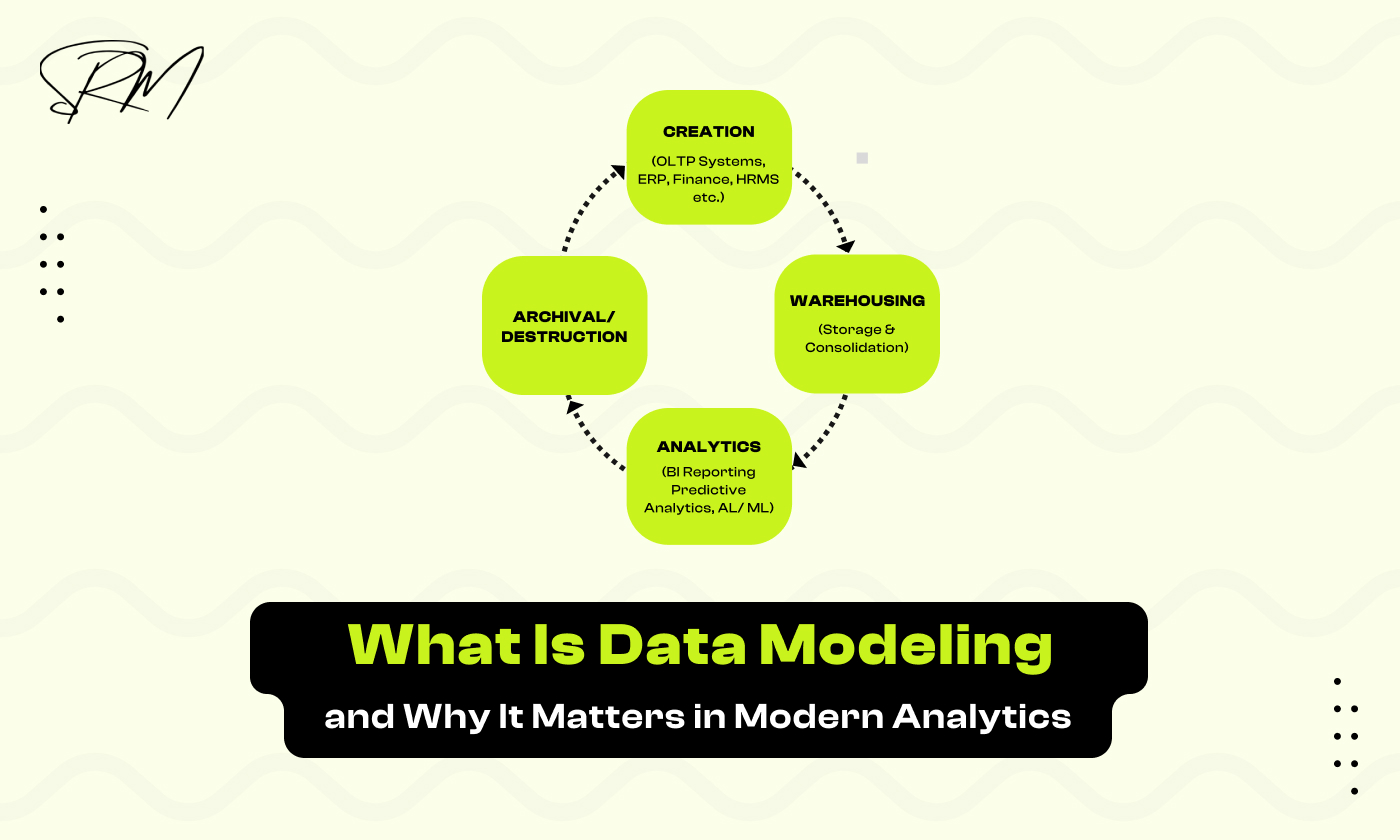
What Is Data Modeling and Why It Matters in Modern Analytics
1. Introduction: Understanding Data Modeling
Every business today runs on data. From sales numbers to customer behavior to website analytics, organizations collect massive amounts of information every day. However, raw data alone cannot provide meaningful insights. It can be confusing, inconsistent, or even misleading if not properly organized. This is where data modeling becomes essential. Data modeling is like creating a blueprint for your data. It helps structure information in a clear and logical way, showing how different pieces of data relate to each other and how they can be used effectively.
A well-designed data model ensures that data is accurate, consistent, and easy to access. This allows analysts, managers, and decision-makers to interpret information quickly and make informed decisions. For example, a retail company can use a proper data model to track customer purchases, identify trends, and predict which products are likely to sell next. Similarly, a healthcare organization can use data models to organize patient records, monitor treatment outcomes, and improve patient care.
Data modeling is not just for database designers or IT teams. It is crucial for anyone who works with data, including business analysts, data engineers, and even executives who rely on accurate reporting. In modern analytics, a strong data model forms the foundation for business intelligence, reporting, dashboards, and AI applications. Without it, organizations risk errors, inefficiencies, and missed opportunities.
Table of Contents
2. What Is Data Modeling?
Data modeling is the process of creating a visual representation of an organization’s data and how it flows between different systems. In simple terms, it is like creating a blueprint for your data, showing how data is organized, connected, and used. A data model helps businesses make sense of large volumes of information by providing structure and context.
At its core, data modeling answers important questions such as:
- What information do we need to store?
- How is this information related to other data?
- How can we organize it so that it is easy to access, understand, and analyze?
By answering these questions, data modeling ensures that data is accurate, consistent, and reliable. It reduces errors, avoids duplication, and allows analysts to focus on extracting meaningful insights instead of cleaning and restructuring data.
Data modeling is used in many areas of modern analytics, including:
- Databases: Structuring tables, fields, and relationships so that data can be stored and retrieved efficiently.
- Data Warehouses: Organizing large volumes of historical and transactional data for reporting and analysis.
- Business Intelligence: Supporting dashboards, reports, and analytics tools with structured, reliable data.
- Data Integration: Ensuring that data from multiple sources is combined in a consistent and usable format.
Data modeling is not a one-time task. As businesses evolve, data requirements change. A flexible and well-maintained data model allows organizations to adapt to new business needs, integrate new data sources, and scale analytics without breaking existing systems.
3. Types of Data Modeling
Data modeling is not a one-size-fits-all process. Depending on the business needs and technical requirements, data modeling is divided into three main types: Conceptual, Logical, and Physical Data Modeling. Each type serves a different purpose and helps organizations structure data effectively.
Each type of data modeling plays a critical role in the overall data management process. While conceptual models help business stakeholders understand the high-level view of data, logical models ensure that the data is organized and consistent for analysis. Physical models take it a step further by optimizing data storage and access for specific database systems. Together, these three types create a comprehensive framework that supports accurate reporting, efficient analytics, and informed decision-making across the organization. By understanding the distinctions and purposes of each type, businesses can design data systems that are scalable, flexible, and aligned with both technical and business goals.
3.1 Conceptual Data Modeling
Conceptual data modeling is the high-level, abstract representation of data. It focuses on understanding the main entities or concepts in a business and the relationships between them, without worrying about technical details.
For example, in an e-commerce business, a conceptual data model might include entities like Customers, Orders, Products, and Payments, and show how they interact. This type of modeling helps stakeholders and business teams visualize the data landscape, clarify requirements, and align on business objectives before moving to more technical models.
Key points about conceptual data modeling:
- Focuses on what data is needed, not how it will be stored.
- Helps with requirement gathering and planning.
- Uses simple diagrams and notations for easy understanding by non-technical users.
3.2 Logical Data Modeling
Logical data modeling is a detailed representation of data that shows how data elements relate to each other. It builds on the conceptual model but adds more structure, including attributes, keys, and relationships, while remaining independent of the database technology.
For instance, a logical data model for the e-commerce example might define Customer ID, Product ID, Order Date, and Payment Method, and show the relationships between tables like Customers and Orders. Logical models are essential for analysts and data architects because they ensure that the data is organized in a way that supports reporting, analysis, and business rules.
Key points about logical data modeling:
- Focuses on how data is structured conceptually.
- Defines attributes, primary keys, foreign keys, and relationships.
- Helps detect inconsistencies and ensures data integrity before physical implementation.
3.3 Physical Data Modeling
Physical data modeling is the technical implementation of the logical model in a specific database system. It defines exactly how data will be stored, retrieved, and optimized for performance. This includes specifying tables, columns, data types, indexes, constraints, and storage requirements.
Continuing with the e-commerce example, a physical data model would define the Customer table with fields like Customer_ID (INT), Name (VARCHAR), Email (VARCHAR), and Address (TEXT). It also defines indexes for faster queries and enforces constraints to maintain data integrity.
Key points about physical data modeling:
- Focuses on implementation in a specific database or data warehouse.
- Optimizes for storage, performance, and retrieval.
- Ensures that the model supports analytics, reporting, and operational systems efficiently.
Understanding these three types of data modeling allows businesses to plan, design, and implement data structures effectively, ensuring that data flows smoothly from collection to analysis. In the next section, we will explore key techniques and approaches used in data modeling that help create robust and scalable data systems.
4. Key Techniques and Approaches
Data modeling is not just about drawing tables and relationships. It involves using proven techniques and approaches to organize data effectively for storage, retrieval, and analysis. Different techniques are suited for different use cases, whether it is designing a database, building a data warehouse, or preparing data for analytics.
These techniques provide a structured way to think about data rather than just storing it arbitrarily. They help ensure that data is not only accurate and consistent but also easy to maintain and scale as the organization grows. By applying the right modeling approach, businesses can simplify complex data relationships, support faster queries, and enable better integration across multiple systems. Whether you are dealing with transactional databases, analytical warehouses, or big data platforms, understanding these key approaches is essential for building a robust and reliable data infrastructure.
4.1 Entity-Relationship (ER) Modeling
Entity-Relationship modeling is one of the most fundamental techniques in data modeling. It focuses on identifying entities, which are things or objects of interest in a system, and the relationships between them.
For example, in a retail system:
- Entities could include Customer, Product, Order, and Supplier.
- Relationships could define how a customer places orders, or how products are supplied.
ER diagrams provide a visual map of data, making it easier for developers and analysts to understand how different parts of a database connect. This technique is widely used in relational database design and helps ensure data integrity by clearly defining primary and foreign keys.
4.2 Dimensional Modeling
Dimensional modeling is often used in data warehousing and business intelligence. It focuses on organizing data to make it easy for users to query and analyze. In this approach, data is divided into facts and dimensions:
- Facts are measurable events, such as sales transactions or website visits.
- Dimensions are descriptive attributes, such as product names, dates, or customer regions.
For example, a sales data warehouse may have a Sales fact table connected to Customer, Product, and Time dimension tables. Dimensional modeling helps create efficient and fast queries, supports analytics and reporting, and is the foundation of techniques like star schema and snowflake schema.
4.3 Normalization and Denormalization
Normalization is a process used to organize data in a database to reduce redundancy and improve integrity. It involves breaking down large tables into smaller, related tables. For example, instead of storing customer information in multiple tables, normalization ensures that all customer details are stored in a single table and referenced wherever needed.
Denormalization, on the other hand, combines tables to improve performance, especially for read-heavy operations like reporting and analytics. It reduces the number of joins required for queries, making data retrieval faster.
Both techniques are critical for balancing data integrity and performance, and the choice between normalization and denormalization depends on the system’s purpose, whether it is transactional (OLTP) or analytical (OLAP).
5. Why Data Modeling Matters in Modern Analytics
In today’s data-driven world, businesses generate massive volumes of information every day. Without proper organization, this data can become overwhelming, inconsistent, and difficult to use effectively. Data modeling provides a structured framework that ensures data is reliable, accessible, and meaningful. By creating clear relationships and structures, data modeling allows organizations to leverage data for accurate insights, better decision-making, and long-term growth.
5.1 Ensures Data Quality and Consistency
One of the biggest challenges in analytics is dealing with inaccurate or inconsistent data. Data modeling helps define rules, relationships, and constraints that maintain data integrity across systems. By ensuring that every data point is consistent and properly linked, organizations can avoid errors and make confident, data-driven decisions. For example, in a retail business, data modeling ensures that customer IDs, orders, and payments are consistently recorded, reducing mistakes in reporting and forecasting.
5.2 Supports Data Warehousing and BI
Data warehouses and business intelligence (BI) tools rely on well-structured data to provide accurate reports and dashboards. Data modeling organizes raw data into meaningful tables and relationships, making it easier to extract insights for strategic planning. Without proper modeling, BI tools might pull incomplete or misleading information, leading to incorrect conclusions. A robust data model ensures that analytical tools have the foundation they need to deliver actionable insights.
5.3 Facilitates Faster Decision-Making
Time is critical in modern business, and decision-makers need access to reliable insights quickly. Data modeling streamlines data organization, allowing analysts and executives to find and interpret data faster. With well-structured data, queries run efficiently, reports are more accurate, and teams can focus on analysis rather than data cleaning. This speed and clarity directly support smarter, faster decisions that can give organizations a competitive edge.
5.4 Enables Scalability for Big Data
As businesses grow, so does their data. Large volumes of information can become unwieldy without a proper framework. Data modeling provides a scalable structure that can handle increasing amounts of data without sacrificing performance or accuracy. It ensures that new data sources can be integrated seamlessly, queries remain efficient, and analytics continue to provide reliable insights even as datasets expand. This scalability is especially important in big data and cloud-based analytics environments, where organizations need to process and analyze massive datasets in real time.
6. Data Modeling in Different Systems
Data modeling is not a one-size-fits-all process. Its implementation varies depending on the type of system being used and the goals of the organization. Understanding how data modeling works across different systems is essential for creating efficient, accurate, and scalable data architectures. Proper modeling ensures that data flows smoothly, supports analytics, and meets business needs effectively.
Different systems have different purposes and workloads, which directly affect how data should be modeled. For example, operational systems that handle daily transactions require highly structured and normalized data to ensure accuracy and consistency. Analytical systems, on the other hand, focus on summarizing and analyzing large volumes of historical data, so they often use denormalized or dimensional models to improve query performance. By understanding the specific requirements of each system, organizations can design data models that are both efficient and flexible, allowing them to extract insights quickly while maintaining data quality across all platforms.
6.1 OLTP vs OLAP Systems
Data modeling differs significantly between Online Transaction Processing (OLTP) and Online Analytical Processing (OLAP) systems because they serve different purposes.
OLTP systems focus on accuracy and efficiency in daily operations. For example, an e-commerce platform uses an OLTP database to store individual customer orders, payments, and inventory updates in a normalized structure to maintain data integrity.
OLAP systems, in contrast, are optimized for analysis and decision-making. They aggregate historical data from multiple sources to provide insights and trends. For instance, a business intelligence dashboard analyzing yearly sales performance would rely on an OLAP model to quickly summarize large datasets.
| Feature | OLTP (Online Transaction Processing) | OLAP (Online Analytical Processing) |
| Purpose | Handles daily operational transactions | Designed for data analysis and reporting |
| Data Structure | Highly normalized to reduce redundancy | Often denormalized using star or snowflake schemas for fast queries |
| Data Volume | Manages small, frequent transactions | Manages large volumes of historical data |
| Performance Focus | Fast inserts, updates, and deletes | Fast query performance and aggregation |
| Example | Recording customer orders or payments in an e-commerce system | Analyzing yearly sales trends or customer behavior through dashboards |
Understanding the differences between OLTP and OLAP modeling ensures that both operational and analytical needs are met efficiently without compromising performance or data integrity.
7. Best Practices for Effective Data Modeling
Creating a data model is more than just defining tables and relationships. To be truly effective, a data model must be aligned with business goals, well-documented, and supported by the right tools. Following best practices ensures that your data model remains accurate, scalable, and useful for analytics, reporting, and decision-making. Well-executed data modeling also reduces costs, avoids redundancy, and enables faster adaptation to changing business needs.
A strong data model acts as a bridge between business requirements and technical implementation, ensuring that the data collected can be effectively transformed into actionable insights. It improves communication between analysts, engineers, and stakeholders, helping teams work more efficiently. Moreover, a well-designed model supports future growth by allowing organizations to integrate new data sources, adopt new technologies, and maintain consistency across multiple systems. In essence, effective data modeling is the foundation for reliable, scalable, and future-proof analytics.
7.1 Align Models with Business Requirements
A data model should reflect the actual needs of the business. Before designing any model, it is crucial to gather input from stakeholders, understand key processes, and identify the types of insights the organization wants to generate. Aligning your data model with business requirements ensures that it captures relevant data, supports decision-making, and avoids unnecessary complexity. For example, an e-commerce company focusing on customer retention should model data around customer interactions, purchases, and loyalty program activities to gain actionable insights. Aligning models with business requirements also helps avoid over-engineering, reduces development time, and ensures the data model supports both current and future analytical needs.
7.2 Document and Maintain Data Models
Documentation is a critical but often overlooked part of data modeling. Well-documented models make it easier for analysts, engineers, and new team members to understand the structure, relationships, and purpose of data. This includes maintaining data dictionaries, diagrams, naming conventions, and notes on relationships and constraints. Additionally, data models should be regularly updated to reflect changes in business processes, new data sources, or evolving analytics needs. Consistent documentation also facilitates communication between technical and non-technical teams, ensures compliance with data governance standards, and reduces the risk of errors when making updates or integrating new systems.
7.3 Use Automation and Modeling Tools
Modern data modeling benefits greatly from automation and specialized tools. Tools like ERwin, Lucidchart, dbt, or SQL-based modeling software can help create accurate diagrams, enforce best practices, and simplify model management. Automation reduces manual errors, ensures consistency across systems, and speeds up the modeling process.
For example, automated tools can generate physical database schemas directly from logical models, saving time and ensuring alignment with technical requirements. Using the right tools also makes it easier to collaborate across teams, track changes, and maintain models over time, especially in organizations managing large or complex datasets.
8. Common Challenges in Data Modeling
Even with the best practices, data modeling comes with its own set of challenges. Organizations often face difficulties when dealing with complex datasets, evolving business requirements, and the need for high-performance models. Understanding these challenges and addressing them proactively is essential for maintaining reliable, scalable, and effective data systems.
Another key challenge is ensuring effective collaboration between technical and non-technical teams. Data modeling often requires input from business stakeholders, data analysts, and IT teams, and miscommunication can lead to models that do not fully meet business needs or are technically inefficient. Aligning all teams, clarifying requirements, and establishing clear workflows for updates and maintenance are essential steps to prevent misunderstandings and ensure that the data model remains accurate, useful, and aligned with organizational goals.
8.1 Handling Complex Data Structures
Modern organizations often work with diverse and complex data sources, including structured databases, unstructured files, and semi-structured formats like JSON or XML. Modeling such data can be challenging because it requires creating relationships and structures that maintain data integrity without slowing down operations.
For example, a healthcare organization might need to model patient records, treatment histories, lab results, and insurance information in a single unified system. Handling these complex structures requires careful planning, advanced modeling techniques, and sometimes a combination of conceptual, logical, and physical models to ensure clarity and usability.
8.2 Managing Changing Business Requirements
Businesses are constantly evolving, and so are their data needs. A model that works today may not be sufficient tomorrow if new processes, products, or data sources are introduced. Managing changing business requirements can be challenging because it often requires updating existing models without breaking existing systems.
For example, an e-commerce company adding a subscription service will need to extend its customer and order models to accommodate recurring payments and new user behaviors. Keeping models flexible, maintaining proper documentation, and planning for scalability are key strategies to handle such changes effectively.
8.3 Ensuring Model Performance
A data model is only valuable if it performs well under real-world conditions. Poorly designed models can lead to slow queries, inefficient storage, and difficulties in analytics, which can impact decision-making. Ensuring model performance involves optimizing data structures, indexing critical fields, balancing normalization and denormalization, and considering system-specific constraints.
For instance, OLAP models for reporting may need denormalized structures for faster aggregation, while OLTP models require normalized tables for efficient transaction processing. Monitoring performance and continuously refining models is crucial for maintaining reliability and speed.
9. FAQs
1. What is the main purpose of data modeling?
Data modeling helps organizations structure and organize data in a clear, logical way so it can be easily stored, retrieved, and analyzed. It ensures consistency, reduces data errors, and supports better decision-making across teams.
2. Do all businesses need data modeling?
Yes. Whether a business is small or large, data modeling helps create a solid foundation for analytics, reporting, and system integrations. Even simple operational processes benefit from a structured understanding of data.
3. How is data modeling different from database design?
Data modeling focuses on defining data requirements, structures, and relationships at a conceptual or logical level. Database design goes a step further by implementing these models physically in a database using tables, indexes, and constraints.
4. Which tools are commonly used for data modeling?
Popular tools include ERwin, Lucidchart, dbt, MySQL Workbench, and Microsoft Visio. These help visualize models, maintain documentation, and automate schema creation.
5. How often should data models be updated?
Data models should be reviewed and updated whenever business processes change, new data sources are added, or analytical requirements evolve. Regular reviews ensure the model remains accurate, relevant, and scalable.
10. Conclusion
Data modeling is the backbone of modern analytics, helping organizations turn raw data into meaningful insights. By structuring data in a clear and organized way, businesses can improve data quality, streamline reporting, and build scalable systems that grow with their needs. Whether it’s supporting real-time operations, powering BI dashboards, or managing complex big data environments, a well-designed data model ensures that the right information is available at the right time.
In a world where data volumes are increasing rapidly, understanding the principles of data modeling is no longer optional. It is a critical skill that helps analysts, engineers, and decision-makers work more efficiently, collaborate better, and deliver results that drive business success. Investing time in creating strong data models today leads to smarter decisions, faster insights, and a more resilient data ecosystem for the future.
As organizations continue to adopt AI, automation, and cloud technologies, the role of data modeling becomes even more important. A solid data model acts as a guiding framework that keeps systems consistent, scalable, and aligned with business goals, even as new tools and technologies are introduced. By prioritizing good modeling practices, companies can future proof their data strategy and ensure that their analytics capabilities remain strong in an increasingly competitive and data-driven world.
December 5, 2025
What Is Data Warehousing? Everything You Need to...

December 5, 2025