
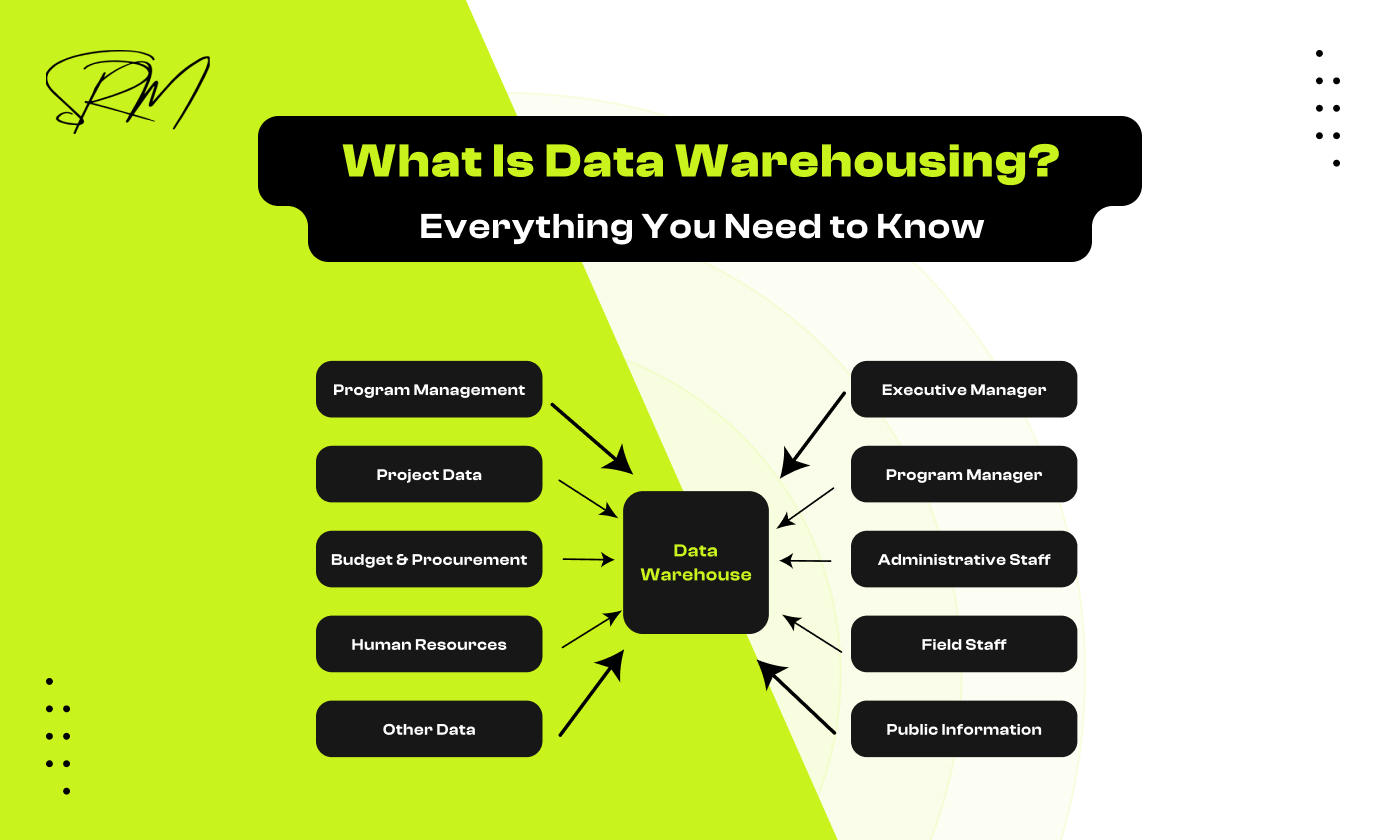
What Is Data Warehousing? Everything You Need to Know
1. Introduction to Data Warehousing
A data warehouse is at the heart of modern analytics. Every time a business wants to understand its sales, customer behavior, marketing performance, or financial trends, there’s one place they turn to: the data warehouse. It acts as the “single source of truth” that brings all business data together, cleans it, and makes it ready for analysis.
Whether it’s a startup tracking customer signups or an enterprise analyzing millions of transactions, data warehousing helps organizations turn raw data into meaningful insights.
A data warehouse is a centralized system where companies store large amounts of data collected from different sources. Unlike regular databases that handle day-to-day transactions, a data warehouse is designed specifically for analysis, reporting, and decision-making.
Think of it as:
- A large, organized library for all your business data
- A place where data is cleaned, structured, and optimized so teams can run queries quickly
- A system that helps businesses understand what happened, why it happened, and what might happen next
A data warehouse turns scattered information into reliable insights.
Table of Contents
2. How a Data Warehouse Works
A data warehouse follows a structured and predictable process. It takes raw data from multiple sources, cleans and organizes it, stores it efficiently, and then makes it available for reporting and analytics. This process ensures that data from different systems, which may be in various formats, can be combined into a single, reliable source. By centralizing and standardizing data, a warehouse enables organizations to analyze trends, monitor performance, and make informed decisions quickly. Essentially, it transforms complex, scattered information into actionable insights that drive business growth and strategy.
2.1 From Raw Data to Insights
Every business generates large volumes of data across different systems. This includes transactions, customer information, website activities, marketing performance, inventory changes, and much more.
However, this raw data is often unorganized, inconsistent, and stored in separate places. Analyzing it directly can be difficult or even impossible.
A data warehouse solves this by:
- Collecting raw data from various systems
- Cleaning and preparing that data
- Structuring it into a unified format
- Making it ready for reporting and analytics
This journey transforms disconnected information into reliable insights that support informed decision-making.
2.2 Data Ingestion, Transformation, and Storage
The core workflow of a data warehouse can be broken down into three major steps: data ingestion, transformation, and storage. These steps ensure that raw, scattered data is converted into a structured and usable format. Each stage plays a critical role in maintaining data accuracy, consistency, and accessibility. Together, they enable businesses to quickly retrieve insights, generate reports, and support advanced analytics without affecting the performance of operational systems.
1. Data Ingestion
This is the process of bringing data into the warehouse from different sources. These sources may include:
- Customer relationship management systems
- Operational databases
- Marketing platforms
- Website and app analytics
- Financial and billing systems
- External APIs and third-party tools
Data ingestion can occur in batches (scheduled intervals) or in real time, depending on business needs.
2. Data Transformation
Raw data often contains duplicates, missing values, inconsistencies, and different formats. Transformation ensures the data is suitable for analysis. This stage typically includes:
- Cleaning and validating data
- Removing errors and duplicates
- Standardizing formats
- Combining data from multiple sources
- Structuring it into tables or models
This step is essential for maintaining accuracy and consistency across reports.
3. Data Storage
Once the data is transformed, it is stored in the warehouse. Storage is optimized for:
- Fast querying
- Scalability
- Easy retrieval
- Historical data tracking
This structured and organized environment allows users to run complex reports without slowing down operational systems.
2.3 How Analytics Tools Extract Value
After the data is stored and ready, analytics and business intelligence tools connect to the warehouse. These tools may include Tableau, Power BI, Looker, or custom dashboards.
They extract value by:
- Running queries to answer specific business questions
- Generating visual dashboards and reports
- Identifying patterns, trends, and KPIs
- Delivering insights to decision-makers
Since the data warehouse is optimized for analysis, these tools can process even large datasets quickly and efficiently.
2.4 Why Businesses Rely on Data Warehousing
Businesses rely on data warehousing because it provides a solid and reliable foundation for data-driven decision-making. By centralizing all business data in one place, a data warehouse ensures that teams across marketing, finance, operations, product, and leadership are working from the same trusted source. This centralization allows organizations to generate accurate and consistent reports while providing faster access to insights. It also improves visibility into operations and performance, enabling leaders to identify trends, monitor progress, and make informed strategic decisions. Additionally, data warehouses support advanced analytics, forecasting, and machine learning, and they allow businesses to track historical data over time, helping to measure growth, detect patterns, and plan for the future effectively.
3. Core Components of a Data Warehouse
A data warehouse is made up of several core components that work together to collect, store, and manage data effectively. Understanding these components is essential to grasp how data warehouses function and why they are critical for businesses. The main components include data sources, ETL/ELT processes, storage layers, compute engines, and metadata management with governance and security. Each component plays a vital role in ensuring that data is accurate, consistent, and accessible, enabling organizations to make informed decisions. Together, these components create a seamless system that transforms raw data into meaningful insights, supporting analytics, reporting, and strategic planning across the business.
3.1 Data Sources and Integration
The first component of a data warehouse is the data sources. These are the systems and applications that generate the raw data needed for business analysis. Common sources include operational databases, CRM platforms, marketing tools, financial systems, and external data feeds. Since this data often comes in different formats and structures, integration is crucial. A data warehouse collects data from all these sources and consolidates it into a single unified system. This ensures that analysts and business users have access to consistent, accurate, and comprehensive datasets, eliminating the need to manually combine data from multiple platforms.
3.2 ETL vs ELT Processes
Data does not enter a warehouse ready for analysis in its raw form. It must first be processed and transformed to make it usable. This is done through ETL (Extract, Transform, Load) or ELT (Extract, Load, Transform) processes.
- ETL (Extract, Transform, Load): Data is extracted from sources, transformed into the correct format, and then loaded into the warehouse.
- ELT (Extract, Load, Transform): Data is first loaded into the warehouse in raw form, and transformations are applied inside the warehouse itself.
The choice between ETL and ELT depends on the data volume, processing requirements, and architecture of the warehouse. Both processes ensure that the data is accurate, consistent, and ready for analysis.
3.3 Storage Layers and Compute Engines
Once data is transformed, it is stored in structured layers designed for easy querying and high performance. Data warehouses often use fact tables and dimension tables, organized in schemas such as Star or Snowflake schemas, to optimize storage and query efficiency.
The compute engine is another critical component, responsible for processing queries and performing calculations on large datasets. Together, storage layers and compute engines allow businesses to run complex queries, generate reports, and analyze large amounts of data without slowing down operational systems.
3.4 Metadata, Governance, and Security
Metadata, governance, and security are essential for maintaining data quality, consistency, and compliance.
- Metadata describes the structure, origin, and meaning of the data, helping users understand and trust the information.
- Data governance ensures that policies and standards are in place for data accuracy, usability, and accessibility.
- Security protects sensitive business and customer information from unauthorized access or breaches, ensuring compliance with regulations like GDPR or HIPAA.
These components work together to make a data warehouse not just a storage system but a reliable, secure, and well-managed environment for business intelligence and analytics.
4. Data Warehouse Architecture
Data warehouse architecture defines how data flows from source systems to storage and finally to analytics and reporting. It determines how efficiently the warehouse handles large volumes of data, supports queries, and scales as business needs grow. There are several architecture types, each with its own advantages and use cases. The most common architectures are single-tier, two-tier, and three-tier. Understanding these architectures helps businesses choose the right structure for performance, scalability, and cost-effectiveness.
4.1 Single-Tier Architecture
Single-tier architecture is the simplest form of data warehouse design. In this model, all operations, data storage, processing, and analytics, occur within a single system. While it reduces complexity and cost, it is rarely used in modern businesses because it struggles to handle large datasets and multiple concurrent queries efficiently. Single-tier architectures are generally suitable only for small-scale operations or experimental projects where data volume and user load are minimal.
4.2 Two-Tier Architecture
Two-tier architecture separates the data storage layer from the client layer used for analysis and reporting. In this model:
- The back-end handles data collection, storage, and basic transformations.
- The front-end provides reporting, dashboards, and analytics for users.
This separation improves performance compared to single-tier architecture and allows users to access reports without directly impacting the storage layer. However, two-tier systems can face limitations when scaling to handle large volumes of data or complex analytics queries.
4.3 Three-Tier Architecture
Three-tier architecture is the most widely used design in modern data warehouses. It introduces an additional middle layer between storage and the user interface:
- Bottom Tier: Data sources and storage. This layer handles raw data from operational systems.
- Middle Tier: ETL processes, data transformations, and a metadata repository. This layer prepares data for analysis.
- Top Tier: Front-end tools for reporting, dashboards, and analytics.
This architecture improves performance, scalability, and flexibility. Multiple users can query data simultaneously without affecting the data storage layer, and it supports advanced analytics and large datasets effectively.
4.4 Performance Impact of Architecture Choices
The choice of architecture significantly affects the speed, scalability, and reliability of a data warehouse:
- Single-tier: Fast for small datasets but limited for large-scale operations.
- Two-tier: Better performance for reporting, but may struggle under heavy workloads or complex queries.
- Three-tier: Offers high scalability, supports multiple users, and ensures that analytics do not slow down operational systems.
Organizations should select an architecture based on their data volume, user requirements, and future growth plans. Choosing the right architecture ensures that the data warehouse remains efficient, reliable, and capable of supporting business intelligence needs over time.
5. Data Warehouse vs Database (and OLTP vs OLAP)
Although data warehouses and databases both store data, they are designed for very different purposes. Understanding the differences between them and between OLTP and OLAP systems is important for managing and analyzing data effectively. Choosing the right system ensures faster performance, accurate reporting, and better decision-making. Using a database for analytics can slow down operational processes, while relying on a data warehouse for transactional tasks would be inefficient. By clearly distinguishing their roles, organizations can optimize both day-to-day operations and strategic insights.
5.1 Purpose and Design Differences
Databases and data warehouses have distinct goals.
Databases, also known as OLTP (Online Transaction Processing) systems, are optimized for day-to-day operations. They handle a large number of transactions such as order entries, customer updates, and payment processing. Their design focuses on fast inserts, updates, and deletes, and they use a normalized structure to reduce redundancy and maintain data accuracy.
Data warehouses, also known as OLAP (Online Analytical Processing) systems, are designed for analysis and reporting. They store historical data from multiple sources and often use denormalized schemas like star or snowflake, which improve query performance and make it easier to generate complex reports and dashboards.
Databases help businesses run daily operations efficiently, while data warehouses help businesses analyze operations and make informed strategic decisions.
5.2 Why Databases Cannot Replace Data Warehouses
Databases are essential for operational tasks but are not suitable for analytics and reporting.
Complex queries on large historical datasets can slow down a database, whereas data warehouses are optimized to handle such queries efficiently. Databases usually store only current transactional data, while data warehouses store historical and aggregated data for trend analysis and forecasting.
Data warehouses also integrate data from multiple sources, creating a single source of truth. Operational databases often work in isolation, making cross-system analysis difficult. Using a data warehouse ensures accurate, consistent, and comprehensive information that can support long-term business decisions.
5.3 OLTP vs OLAP with Simple Examples
OLTP (Online Transaction Processing) and OLAP (Online Analytical Processing) systems serve different purposes and are optimized for different types of workloads.
OLTP systems handle day-to-day operational tasks. They focus on high-speed, high-volume transactions, ensuring data is updated accurately and efficiently. Example: A retail point-of-sale system recording each customer purchase in real time, or a banking system processing deposits and withdrawals. OLTP systems are optimized for short, frequent queries and maintain the integrity of current data. They are essential for keeping business operations running smoothly.
OLAP systems are designed for analysis and decision-making. They focus on complex queries, aggregations, and historical data analysis. Example: A retail manager analyzing monthly sales trends across all stores, identifying top-selling products, or forecasting inventory needs based on seasonal patterns. OLAP systems allow businesses to explore trends, generate reports, and uncover insights that are not possible in transactional databases.
Key differences:
| Feature | OLTP | OLAP |
| Purpose | Transactional operations | Analytical queries |
| Data Type | Current, live data | Historical and aggregated |
| Queries | Simple and frequent | Complex and less frequent |
| Users | Clerks, employees | Analysts, managers |
| Example | Order entry, banking transactions | Sales trend analysis, financial forecasting |
Understanding OLTP and OLAP helps businesses ensure that operational efficiency and analytical capabilities work together without interfering with each other.
6. Types of Data Warehouses
Data warehouses are not one-size-fits-all. Depending on business needs, technical requirements, and budget, organizations can choose from several types of data warehouses. The main types include on-premise, cloud, hybrid, and virtual data warehouses. Each type has unique characteristics, advantages, and limitations. Understanding these differences helps businesses make the right choice and ensures that the warehouse can scale and perform efficiently over time.
6.1 On-Premise Data Warehouses
On-premise data warehouses are installed and managed locally on a company’s own servers and infrastructure. Businesses have full control over hardware, software, and security protocols, allowing them to customize the system for specific operational needs.
Advantages:
- Full control over hardware, storage, and software configurations.
- Strong security measures since data is stored within the organization’s infrastructure.
- Easier compliance with strict regulations or industry standards, such as financial or healthcare requirements.
Limitations:
- High upfront costs for hardware, software licenses, and IT staffing.
- Maintenance, updates, and scaling require time, effort, and expertise.
- Limited flexibility to quickly adapt to sudden increases in data volume.
Use case: Large enterprises or organizations with sensitive data that must remain on-site, such as banks, healthcare providers, or government agencies, often prefer on-premise warehouses for better control and compliance.
6.2 Cloud Data Warehouses
Cloud data warehouses are hosted by third-party providers like Amazon Redshift, Google BigQuery, or Snowflake. They are accessed over the internet, eliminating the need for physical infrastructure on-site.
Advantages:
- Scalability: Easily handle growing data volumes without major hardware investments.
- Lower upfront costs: Pay-as-you-go pricing reduces the need for heavy initial investment.
- Minimal maintenance: Cloud providers manage updates, infrastructure, and security.
- Faster deployment: Organizations can launch a cloud warehouse quickly without complex setup.
Limitations:
- Less control over hardware and storage, which may be a concern for highly regulated data.
- Data transfer costs can increase if large datasets are frequently moved between cloud and on-premise systems.
- Reliance on internet connectivity for access and performance.
Use case: Organizations looking for rapid deployment, reduced IT overhead, and flexible scalability often choose cloud warehouses. They are particularly suitable for startups, growing companies, or businesses with fluctuating workloads.
6.3 Hybrid and Virtual Data Warehouses
Hybrid data warehouses combine on-premise and cloud environments, giving businesses flexibility to store sensitive data locally while leveraging the cloud for other workloads. Virtual data warehouses provide a logical integration layer that allows querying multiple sources without physically moving all data into a single location.
Advantages:
- Combines security of on-premise storage with the scalability and flexibility of the cloud.
- Virtual warehouses support real-time analytics across multiple data sources.
- Can optimize costs by storing frequently accessed data in the cloud and sensitive or infrequently used data on-premise.
Limitations:
- Setup and management can be complex due to integration across environments.
- Requires robust data governance and monitoring to ensure data consistency and accuracy.
- Performance may be affected if queries span multiple locations or systems.
Use case: Businesses with regulatory requirements that restrict cloud storage for certain datasets, or companies working with multiple distributed data sources, often choose hybrid or virtual warehouses. They are ideal for organizations needing flexibility without sacrificing control or security.
6.4 Choosing the Right Type for Your Needs
Selecting the right type of data warehouse depends on several factors:
- Data volume and growth: Large-scale operations with growing data may benefit from cloud or hybrid solutions for easier scaling.
- Security and compliance: Highly regulated industries may need on-premise storage for sensitive data.
- Cost considerations: Cloud warehouses reduce upfront costs but may incur ongoing usage fees.
- IT resources: On-premise systems require dedicated IT staff, while cloud solutions reduce maintenance overhead.
- Analytics requirements: Complex analytics and real-time reporting may be easier with cloud or hybrid architectures.
By carefully evaluating these factors, businesses can choose a warehouse type that balances control, performance, and cost while supporting both current and future analytics needs.
7. Benefits and Real-World Use Cases
A data warehouse offers significant advantages for businesses of all sizes. By consolidating data from multiple sources into a single, reliable system, organizations can improve performance, gain deeper insights, and make smarter decisions. Beyond the technical benefits, data warehouses have practical applications across various industries, helping companies leverage data to solve real-world problems. They also enable teams to track long-term trends, identify patterns, and respond proactively to business challenges. With a centralized and consistent source of data, organizations can ensure alignment across departments, improve collaboration, and support strategic initiatives more effectively.
7.1 Speed, Scalability, and Reporting Accuracy
One of the primary benefits of a data warehouse is speed and performance. By organizing data efficiently and separating analytical workloads from operational systems, queries run faster, even on large datasets. This allows teams to generate accurate and timely reports without slowing down transactional systems.
Data warehouses are also highly scalable, meaning they can handle growing data volumes as businesses expand. Whether it is daily transactions, historical data, or real-time analytics, a properly designed warehouse can support increasing demands without compromising performance. This scalability ensures that organizations can continue to derive insights as their data and business needs grow.
Additionally, centralizing data in a warehouse improves reporting accuracy. With a single source of truth, teams across finance, marketing, operations, and leadership work with consistent, reliable data, reducing errors and discrepancies in reports or analyses.
7.2 Better Decision-Making with Unified Data
By consolidating data from multiple sources, a data warehouse provides a holistic view of the business. Decision-makers can access historical trends, cross-departmental data, and aggregated metrics to make informed, strategic choices.
For example, marketing teams can analyze campaign performance alongside sales and customer behavior data, while finance teams can track revenue trends and forecast budgets accurately. Having unified, high-quality data allows companies to identify opportunities, uncover inefficiencies, and respond proactively to market changes.
The availability of clean, consistent data also enables advanced analytics, including predictive modeling, forecasting, and machine learning, helping organizations plan for the future with confidence.
7.3 Use Cases in Retail, Finance, Healthcare, and SaaS
Data warehouses are widely used across industries to solve specific business challenges:
- Retail: Track sales trends, inventory levels, and customer preferences to optimize stock, marketing campaigns, and store performance.
- Finance: Consolidate transaction records, monitor financial performance, and detect anomalies or fraud across multiple accounts or branches.
- Healthcare: Analyze patient records, treatment outcomes, and resource utilization to improve patient care, reduce costs, and meet compliance requirements.
- SaaS and Technology: Monitor user behavior, subscription metrics, and system performance to improve product development, customer retention, and support services.
In each case, the data warehouse transforms raw data into actionable insights, enabling businesses to make faster, smarter decisions and remain competitive in their industries.
8. Popular Tools, Challenges & Best Practices
Building and maintaining a data warehouse requires the right tools, awareness of potential challenges, and adherence to best practices. Choosing the right platform can simplify management, improve performance, and reduce costs. At the same time, businesses must plan for common challenges and implement strategies to keep their data warehouse efficient, scalable, and reliable.
8.1 Leading Warehouse Platforms
Several modern data warehouse platforms have become industry standards due to their performance, scalability, and integration capabilities.
- Snowflake: A cloud-based platform that separates storage and compute, allowing organizations to scale resources independently. Snowflake is known for its fast performance, ease of use, and support for semi-structured data.
- Amazon Redshift: Part of the AWS ecosystem, Redshift offers fast querying capabilities, tight integration with AWS tools, and robust security features. It is suitable for large-scale analytics on structured data.
- Google BigQuery: A fully managed serverless data warehouse that enables real-time analytics. BigQuery supports massive datasets, offers fast querying, and integrates easily with Google Cloud services.
- Microsoft Azure Synapse: Formerly SQL Data Warehouse, Synapse combines big data and data warehousing capabilities. It is ideal for organizations already invested in the Azure ecosystem and provides deep integration with analytics tools.
Choosing the right platform depends on factors like data volume, cloud strategy, budget, and analytics requirements.
8.2 Common Challenges
Even with the best tools, managing a data warehouse comes with challenges:
- Data quality issues: Inconsistent, incomplete, or inaccurate data from multiple sources can reduce reliability and lead to flawed insights. Proper ETL/ELT processes and data validation are critical.
- Cost management: Cloud platforms offer flexibility, but costs can escalate with growing data volumes or frequent queries. Monitoring usage and optimizing resource allocation is essential.
- Scalability and performance: As organizations grow, warehouses must handle increasing data volumes and user queries. Poorly designed architectures can lead to slow performance and delays in reporting.
- Integration complexities: Combining data from multiple sources, including on-premise systems, cloud apps, and third-party tools, can be challenging and requires robust integration strategies.
Being aware of these challenges early helps organizations proactively plan and avoid common pitfalls.
8.3 Best Practices for an Efficient Data Warehouse
Implementing best practices ensures a data warehouse remains reliable, scalable, and valuable:
- Plan architecture carefully: Choose a structure (star, snowflake, or hybrid) that aligns with business needs and query patterns.
- Maintain data quality: Use proper ETL/ELT processes, validation rules, and periodic audits to ensure data accuracy.
- Monitor performance: Track query execution times, storage usage, and user activity to identify bottlenecks.
- Implement security and governance: Ensure data privacy, access controls, and compliance with regulations such as GDPR or HIPAA.
- Document and train: Maintain clear documentation for processes, schemas, and transformations, and provide training to teams using the warehouse.
- Leverage automation: Use automated ETL pipelines, backups, and monitoring to reduce manual effort and human error.
Following these best practices helps organizations maximize the value of their data warehouse while minimizing costs, risks, and performance issues.
9. Frequently Asked Questions (FAQs)
1. What is the main difference between a data warehouse and a database?
A database is designed for daily operations, handling transactions quickly and efficiently. A data warehouse is optimized for analysis, reporting, and storing historical data from multiple sources. Databases run OLTP operations, while data warehouses support OLAP queries.
2. How does a data warehouse help businesses make better decisions?
A data warehouse consolidates data from various sources into a single, trusted system. This unified view allows businesses to analyze trends, generate accurate reports, forecast future outcomes, and make data-driven decisions across departments.
3. What are the most popular data warehouse tools used today?
Some leading platforms include Snowflake, Amazon Redshift, Google BigQuery, and Microsoft Azure Synapse. Each platform offers scalability, performance, and integration capabilities for analytics and reporting.
4. Can a small business benefit from a data warehouse?
Yes. Even small businesses can use a data warehouse to organize data from multiple sources, improve reporting accuracy, and gain insights that help optimize marketing, sales, and operations. Cloud solutions make it affordable and easy to scale.
5. What are the common challenges when managing a data warehouse?
Common challenges include data quality issues, high costs, integration complexities, and performance bottlenecks. Following best practices such as proper ETL processes, monitoring, and governance can help overcome these challenges.
10. Conclusion & Key Takeaways
Data warehouses play a crucial role in modern business by consolidating data from multiple sources into a single, reliable system. They empower organizations to make data-driven decisions, improve reporting accuracy, and gain deeper insights into operations. From speeding up analytics to enabling advanced forecasting and machine learning, data warehouses provide a foundation for both efficiency and strategic growth.
Choosing the right type of data warehouse, whether on-premise, cloud, hybrid, or virtual, depends on factors like budget, scalability, security, and analytics needs. Using the right tools, addressing common challenges, and following best practices ensures that a data warehouse remains efficient, scalable, and valuable over time.
Businesses of all sizes can benefit from a well-designed data warehouse. By leveraging a centralized and structured data platform, teams can unlock actionable insights, improve collaboration, and make smarter decisions that drive long-term success.
As organizations continue to generate increasing volumes of data, the importance of a robust data warehouse grows. Companies that invest in building and optimizing their data warehouses are better positioned to respond to market trends, understand customer behavior, and gain a competitive edge. A well-maintained data warehouse is not just a technical asset; it is a strategic tool that supports growth, innovation, and informed decision-making across the entire organization.
December 3, 2025
ETL vs ELT: What’s the Difference and Which...
December 3, 2025