
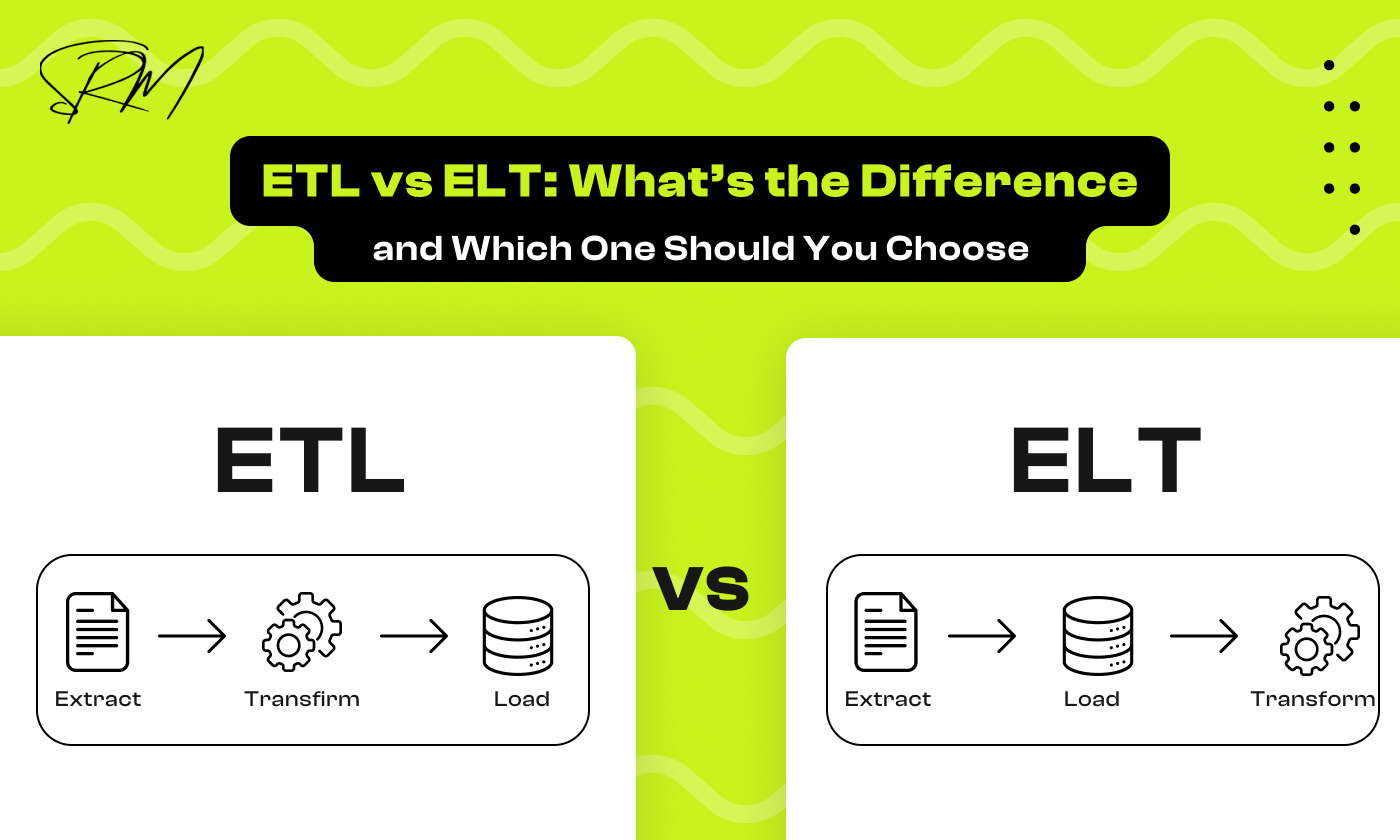
ETL vs ELT: What’s the Difference and Which One Should You Choose
1. Introduction: Why Understanding the Difference Matters for Modern Data Pipelines
Data is everywhere today – from the apps we use to the businesses we rely on. But having data isn’t enough. The real challenge is how you move it, transform it, and make it useful. That’s where ETL and ELT come in.
At first glance, ETL (Extract, Transform, Load) and ELT (Extract, Load, Transform) might seem like just fancy technical terms. But the way you choose to handle your data can have a big impact on how fast you get insights, how much it costs, and how easy it is to scale your systems.
ETL and ELT are different strategies for getting raw data from one place to another, while making it ready for analysis. The choice between them affects everything from your data processing speed to your ability to handle complex queries, especially in cloud environments where data is growing exponentially.
Moreover, businesses today want data pipelines that are not just efficient but also flexible. Some workflows require heavy transformations before the data is even usable, while others benefit from loading raw data first and transforming it later. Understanding these differences is key to designing a pipeline that is both powerful and cost-effective.
Whether you’re a data engineer, analyst, or business leader, knowing the strengths and limitations of ETL and ELT will help you make smarter decisions, avoid common pitfalls, and build a system that grows with your data needs.
Table of Contents
2. What is ETL?
ETL, short for Extract, Transform, Load, is one of the most traditional and widely used methods for moving and preparing data for analysis. It’s been the backbone of data pipelines for decades, especially in on-premises and traditional data warehouse environments. Let’s break it down step by step.
2.1 Definition and Process (Extract, Transform, Load)
ETL is a three-step process that takes raw data from different sources and turns it into clean, structured information ready for analysis:
- Extract – This is the first step where data is pulled from various sources such as databases, spreadsheets, CRM systems, or APIs. The idea is to collect all the relevant data, no matter the format or location.
- Transform – Once extracted, the data is cleaned, formatted, and structured to match the target system’s requirements. This may involve removing duplicates, standardizing units, combining fields, or applying business rules.
- Load – Finally, the transformed data is loaded into the target data warehouse or reporting system, where it can be accessed for analysis, reporting, or visualization.
Think of it like preparing ingredients before cooking. You extract raw materials, clean and chop them (transform), and finally plate them for the meal (load).
2.2 How ETL Works in Traditional Data Warehouses
In traditional data warehouses, ETL happens before the data enters the warehouse. This means all transformations are applied upfront, ensuring that the data is already structured and optimized for queries when loaded.
For example, a retail company using a legacy warehouse might extract sales, customer, and inventory data from multiple databases, transform it into a consistent format, and load it into a centralized warehouse for reporting. Analysts and business users can then run dashboards or reports without worrying about messy raw data.
2.3 Key Advantages and Limitations
ETL has been the go-to approach for decades because it ensures that data entering a warehouse is clean, structured, and ready for analysis. By transforming data before loading, it helps maintain high data quality and consistency, which is critical for accurate reporting and decision-making. However, this upfront processing can also make ETL pipelines slower and less flexible, especially when dealing with large volumes of data or evolving business requirements. Understanding these pros and cons will help you decide whether ETL is the right approach for your organization.
Advantages:
- Clean and consistent data: Data is transformed before it reaches the warehouse, making it ready for immediate use.
- Reliable for structured workloads: Works well for traditional reporting and BI dashboards.
- Control over transformations: Since transformations happen before loading, there’s more control over data quality.
Limitations:
- Slower for large volumes: Processing massive datasets can take time, especially in on-premise systems.
- Less flexible: Changes in business requirements often require redesigning the ETL pipeline.
- Not ideal for real-time analytics: ETL is batch-oriented, making it less suitable for streaming or near real-time data.
ETL remains a solid choice for organizations with structured data and well-defined reporting needs, but as data grows in volume and variety, modern approaches like ELT are gaining popularity.
3. What is ELT?
ELT, which stands for Extract, Load, Transform, is a modern approach to data processing that has become increasingly popular with the rise of cloud data warehouses and data lakes. Unlike ETL, ELT loads raw data directly into the destination system first and then applies transformations inside the warehouse or lake. This approach leverages the power and scalability of modern cloud infrastructure to handle large and complex datasets efficiently.
3.1 Definition and Process (Extract, Load, Transform)
The ELT process also has three main steps, but in a slightly different order:
- Extract – Data is collected from various sources, just like in ETL.
- Load – Instead of transforming the data upfront, ELT loads raw data directly into the target system, such as a cloud data warehouse or data lake.
- Transform – Transformations are performed inside the warehouse or lake using its processing power. This can include cleaning, aggregating, joining datasets, or applying business rules.
Think of it like throwing all your ingredients into the kitchen first, then chopping, mixing, and cooking everything right there. This approach takes advantage of the warehouse’s compute capabilities to handle transformations at scale.
3.2 How ELT Works in Cloud Data Warehouses and Lakes
ELT shines in cloud environments because modern warehouses like Snowflake, BigQuery, or Redshift are designed to efficiently process large datasets. Raw data is loaded directly, and transformations are applied as needed, often on-demand.
For example, a streaming platform might load raw user activity logs into a data lake. Analysts or data engineers can then transform only the specific datasets they need for a report or model, without waiting for the entire pipeline to process. This approach makes ELT more flexible, scalable, and faster for complex and large-volume data workflows compared to traditional ETL.
3.3 Key Advantages and Limitations
ELT offers several benefits but also comes with trade-offs. It allows organizations to load raw data quickly and transform it on-demand, which is perfect for agile teams that need flexible reporting and advanced analytics. At the same time, because transformations happen inside the warehouse, it relies heavily on the system’s processing power, and without proper management, it can lead to higher costs or performance issues. Understanding these advantages and limitations is key to deciding if ELT fits your business needs and technical environment.
Advantages:
- Handles large volumes of data efficiently in the cloud.
- Flexible transformations – you can transform data as needed without redesigning pipelines.
- Ideal for real-time or on-demand analytics and AI/ML workloads.
Limitations:
- Requires powerful cloud infrastructure, which can increase costs.
- Raw data in the warehouse may need careful governance to maintain quality.
- May not be ideal for legacy on-premise systems without sufficient compute resources.
ELT is increasingly the go-to approach for modern data pipelines, especially for companies leveraging cloud data warehouses and lakes, offering speed, scalability, and flexibility that traditional ETL often struggles to provide.
4. ETL vs ELT: Head-to-Head Comparison
Now that we’ve explored ETL and ELT individually, it’s time to see how they stack up against each other. Understanding these differences is crucial for building efficient, scalable, and cost-effective data pipelines. Choosing the right approach depends on your data volume, processing needs, and the type of warehouse or lake you’re using.
The choice between ETL and ELT also impacts how quickly you can access insights, how flexible your pipelines are to changing business requirements, and the total cost of managing your data infrastructure. By comparing them side by side, you can make a more informed decision on which strategy aligns with your organization’s goals, whether it’s traditional reporting, advanced analytics, or real-time AI applications. This comparison will help clarify the strengths and trade-offs of each approach, so you can design a pipeline that is both robust and future-ready.
4.1 Data Processing Order
One of the biggest differences between ETL and ELT is when and where the data is transformed. This difference is important because it affects the flexibility, speed, and usability of your data. The order in which you process data can determine whether your pipelines are rigid or adaptable to changing business needs.
ETL: Data is extracted from sources, transformed before being loaded into the warehouse, and then stored in a clean, structured format. This ensures that the data is ready for analysis immediately, but upfront transformations can slow down pipelines when dealing with very large or complex datasets.
ELT: Data is extracted and loaded into the warehouse first, and then transformations are applied inside the warehouse or data lake. This allows teams to work with raw data, experiment with different queries, and run multiple analytics processes without redesigning the pipeline.
Think of ETL as preparing all ingredients perfectly before cooking, while ELT is like loading everything into the kitchen and cooking as needed, making it more adaptable for evolving business requirements.
4.2 Performance Considerations
Performance is a key factor when designing data pipelines. How efficiently your data moves and transforms can impact reporting speed, analytics, and even downstream decision-making.
ETL: Works well for structured, predictable workloads with smaller datasets. Because transformations happen outside the warehouse, ETL can reduce the computational load on your warehouse. However, as data volumes grow, ETL pipelines can become slower and harder to maintain, especially in batch processing scenarios.
ELT: Designed for modern cloud warehouses with high processing power. ELT can handle large datasets, streaming data, and complex analytics more efficiently because the transformation happens inside the warehouse using its compute engine. This approach supports real-time insights and machine learning workflows but requires sufficient cloud resources to avoid bottlenecks.
4.3 Scalability and Flexibility
Scalability and flexibility are crucial for modern data-driven businesses. Your data pipelines must accommodate growing data volumes, new sources, and changing analytics needs.
ETL: Scalability can be limited because each new data source or transformation often requires reworking the pipeline. ETL works best when your data is structured and stable, and your business processes don’t change frequently.
ELT: Highly scalable and flexible. Since raw data is already in the warehouse or lake, you can perform on-demand transformations for different analytics or machine learning models without modifying the original pipeline. ELT is ideal for dynamic environments, where teams experiment with new queries, datasets, or AI models frequently.
ETL is predictable but rigid, while ELT is adaptable and future-ready, making it a strong choice for cloud-first organizations.
4.4 Cost Implications
Cost is another critical consideration when deciding between ETL and ELT, especially for organizations using cloud infrastructure or large datasets.
ETL: Often cheaper in traditional setups, as heavy transformations happen outside the warehouse, reducing the need for expensive compute resources. Storage requirements may also be lower since only transformed data is loaded.
ELT: Can incur higher cloud compute costs, especially with large datasets or complex transformations inside the warehouse. However, the ability to process raw data on-demand can save time and operational overhead, offsetting the cost for organizations that rely on flexible analytics, real-time reporting, or AI-driven workflows.
4.5 Security and Compliance Differences
Security and compliance are essential for handling sensitive data and meeting industry regulations. The way data flows through your pipelines directly impacts governance and risk management.
ETL: Since data is cleaned and transformed before it enters the warehouse, ETL pipelines make it easier to enforce governance, compliance, and access controls. Sensitive data can be masked or removed during transformation, reducing risk.
ELT: Raw data is loaded directly into the warehouse, so careful planning is needed to manage access, compliance, and sensitive information. Strong governance policies, role-based access, and auditing are critical to ensure data security.
ELT gives flexibility but requires a proactive approach to data security, especially in highly regulated industries like finance or healthcare.
5. When to Choose ETL and ELT
Choosing between ETL and ELT is not just a technical decision, it’s a strategic choice that impacts how efficiently your organization can collect, process, and analyze data. Factors such as data complexity, volume, source systems, analytics goals, and infrastructure all play a role in determining which approach will work best. Understanding the ideal scenarios for each method ensures that your pipelines are efficient, scalable, and cost-effective, while also meeting business and compliance needs.
5.1 Use Cases Ideal for ETL
ETL is best suited for scenarios where data needs to be cleaned, standardized, and structured before it is analyzed. By transforming data upfront, ETL ensures that the information loaded into your warehouse is consistent, accurate, and immediately usable.
Common ETL use cases include:
- Financial reporting: Ensures all transactional and account data is standardized for accurate reporting and auditing.
- Regulatory compliance: Critical in industries like finance, healthcare, or insurance, where sensitive data must meet strict compliance standards.
- Historical reporting and batch processing: ETL is ideal for processing large volumes of structured historical data in scheduled batches.
- Operational dashboards and BI tools: ETL pipelines deliver clean, reliable data for business intelligence, avoiding inconsistent or messy reporting results.
ETL is perfect when control, consistency, and data quality take priority over flexibility or immediate access to raw data.
5.2 Use Cases Ideal for ELT
ELT is designed for modern, cloud-based data environments where flexibility, speed, and scalability are critical. By loading raw data first and transforming it inside the warehouse, ELT allows teams to work with multiple types of analytics and respond quickly to changing business requirements.
Typical ELT use cases include:
- Big data analytics: Handles massive datasets directly in the warehouse or data lake for high-performance querying.
- Real-time reporting and dashboards: Supports near real-time insights, making it ideal for operational monitoring.
- Machine learning and AI pipelines: Analysts can transform raw data as needed for training multiple models without redesigning pipelines.
- Ad-hoc analysis and experimentation: ELT enables analysts to run experiments or explore new questions without waiting for pre-processed data.
ELT is ideal when agility, on-demand transformations, and scalability are the top priorities for your data strategy.
5.3 Industries and Scenarios Where ETL Shines
ETL works best in industries that require high levels of data governance, structured reporting, and strict compliance:
- Banking and finance: Regulatory requirements demand structured, validated, and compliant data before reporting or analysis.
- Healthcare: Patient records, insurance claims, and clinical data must be cleaned, standardized, and compliant with regulations like HIPAA.
- Insurance: Risk assessments and policy data need consistent formatting and validation before reporting.
- Government and public sector: Strong auditing and compliance standards make ETL pipelines ideal for accurate reporting.
In these scenarios, ETL ensures that data entering the warehouse is reliable, governed, and ready for analysis, minimizing errors and compliance risks.
5.4 Industries and Scenarios Where ELT is Preferred
ELT is increasingly favored in cloud-first, data-intensive industries that need fast, flexible, and scalable data pipelines:
- E-commerce: Handles large-scale customer behavior and transaction data to deliver personalization and analytics at scale.
- SaaS and technology: Supports real-time product usage analytics and operational monitoring.
- Media and entertainment: Efficiently processes streaming data, user interactions, and content analytics.
- Telecommunications and IoT: Manages large volumes of network or device data for real-time decision-making.
ELT allows teams to experiment with raw data, run multiple types of analytics, and iterate quickly, making it perfect for fast-moving industries that rely on data agility.
5.5 Examples of Popular ETL Tools
ETL tools are designed for structured pipelines, controlled transformations, and compliance-heavy workflows. Popular ETL tools include:
- Informatica PowerCenter – Enterprise-grade ETL platform for complex workflows and governance.
- Talend – Open-source and cloud-ready tool for structured data pipelines with strong transformation capabilities.
- Microsoft SQL Server Integration Services (SSIS) – Widely used in Microsoft-centric environments for batch ETL.
- IBM DataStage – Handles large-scale ETL processes in enterprise systems.
- Oracle Data Integrator (ODI) – Robust tool for traditional ETL pipelines with governance support.
These tools are ideal when pre-transformation, structured workflows, and compliance are critical.
5.6 Examples of Popular ELT Tools
ELT tools focus on loading raw data first and transforming it inside cloud warehouses, enabling scalability and flexibility. Popular ELT tools include:
- Fivetran – Automates extraction and loading for cloud data warehouses with minimal maintenance.
- Stitch – Lightweight ELT tool for fast integration of multiple data sources.
- dbt (Data Build Tool) – SQL-based tool for transforming data inside warehouses like Snowflake or BigQuery.
- Airbyte – Open-source ELT platform for cloud pipelines with flexible connectors.
- Matillion – Cloud-native ELT tool for Snowflake, Redshift, and BigQuery, designed for scalable transformations.
These tools are ideal for cloud-first analytics, on-demand transformations, and scalable workflows.
6. ETL vs ELT in Modern Cloud Data Architecture
As organizations move to the cloud, the way data is ingested, processed, and analyzed is changing rapidly. Modern cloud architectures allow scalable, flexible, and cost-effective data pipelines, making it essential to understand how ETL and ELT fit into these environments. In this section, we’ll explore cloud data warehouses vs data lakes, hybrid approaches, and migration strategies to help you leverage the best of both worlds.
6.1 Cloud Data Warehouses vs Data Lakes
Cloud data warehouses are optimized for high-performance analytics and structured data, making them ideal for BI and reporting. Data lakes, on the other hand, are designed to store raw, unstructured data at massive scale, supporting AI, machine learning, and exploratory analytics. Using this table helps readers quickly understand which architecture is suitable for different data workloads and how ETL vs ELT fits into each scenario.
| Feature | Cloud Data Warehouse | Data Lake |
| Data Type | Structured & semi-structured | Structured, semi-structured, unstructured |
| Use Case | BI, reporting, analytics | Big data, AI/ML, exploratory analysis |
| Performance | High-performance queries | Flexible storage, optimized for volume |
| Transformation | ELT-friendly (transform in warehouse) | Transform on-demand, schema-on-read |
| Storage Cost | Higher (optimized for speed) | Lower (optimized for scale) |
| Examples | Snowflake, BigQuery, Redshift | AWS S3, Azure Data Lake, GCS |
Key takeaway: ETL is often used with structured warehouses requiring pre-processed data, while ELT thrives in cloud-first architectures that leverage warehouse compute power or data lakes for raw data transformations.
6.2 Hybrid Approaches and Best Practices
Many modern organizations adopt a hybrid approach, combining ETL and ELT to balance control, performance, and flexibility:
- Use ETL for critical, compliance-heavy datasets: Transform sensitive data before loading to ensure governance and accuracy.
- Use ELT for scalable, cloud-native workloads: Load raw data into warehouses or lakes and transform on-demand for analytics, ML, or ad-hoc reporting.
Best practices:
- Automate pipelines with orchestration tools like Airflow or Prefect.
- Monitor and optimize performance to avoid unnecessary cloud compute costs.
- Implement governance and security policies to manage sensitive data across both ETL and ELT workflows.
- Segment workloads based on data criticality, frequency, and transformation complexity.
Hybrid strategies allow organizations to get the best of both ETL and ELT, optimizing cost, performance, and flexibility in a single architecture.
6.3 Migration Strategies from ETL to ELT
Many organizations with legacy ETL pipelines are now migrating to ELT to take advantage of cloud scalability and modern analytics: This structured approach ensures that your migration from ETL to ELT is safe, efficient, and scalable. Gradual migration allows teams to test cloud transformations, monitor performance, and optimize pipelines without disrupting business operations. It also ensures that data quality and governance are maintained throughout the process.
Step 1: Assess Existing ETL Pipelines
Start by carefully reviewing all your existing ETL workflows. Identify which pipelines are high-volume, compute-intensive, or critical for business operations. Understand the transformation logic, dependencies, and data quality rules currently applied. This assessment will help you determine which processes are suitable for migration and which might require redesign or optimization for ELT.
Step 2: Prioritize Workloads for Migration
Not all pipelines should be migrated at once. Begin with non-critical datasets or those that will benefit most from ELT’s cloud-based flexibility and scalability. Testing ELT transformations on these datasets first provides valuable insights into performance, resource usage, and potential challenges, without impacting mission-critical operations.
Step 3: Select the Right ELT Tools
Choosing the right ELT tools is crucial for a smooth migration. Cloud-native tools like Fivetran, dbt, or Matillion can automate data extraction, loading, and transformation within modern data warehouses. Ensure the tools you select integrate well with your target warehouse or data lake and support your specific transformation requirements.
Step 4: Implement Governance and Security
Even during migration, data governance and security cannot be compromised. Implement role-based access, auditing, and validation checks in the ELT environment. Sensitive data should be properly masked or encrypted, and compliance policies must be applied consistently throughout the migration process to maintain regulatory adherence.
Step 5: Execute Migration Gradually
Migrate your pipelines in phases rather than attempting a full-scale switch all at once. Start with simpler, lower-risk workflows to test performance and transformation logic in the ELT environment. Monitor pipeline execution, validate results, and address any bottlenecks before moving on to more complex or critical datasets.
Step 6: Optimize and Scale
Once initial migrations are successful, refine transformation logic to maximize efficiency and reduce compute costs. Gradually scale the ELT pipelines to handle larger and more complex datasets. Continuous monitoring, optimization, and iterative improvements ensure your ELT architecture delivers faster insights, greater flexibility, and better scalability than traditional ETL pipelines.
Migration from ETL to ELT allows organizations to unlock faster insights, reduce operational overhead, and scale analytics for modern business needs while maintaining control over critical data.
7. Common Mistakes to Avoid
Even experienced data teams can make mistakes when choosing between ETL and ELT. These errors can result in slow pipelines, high costs, or poor data quality, which ultimately affect business decisions. Understanding these pitfalls ahead of time can save time, resources, and operational headaches. Data pipelines are the backbone of any analytics or AI strategy, and even small missteps can cascade into bigger operational problems. By identifying these common errors, organizations can not only improve efficiency and accuracy but also ensure that their data architecture remains scalable, flexible, and future-proof. Avoiding these mistakes helps teams focus on deriving insights quickly and reliably, rather than spending time troubleshooting preventable issues.
7.1 Misunderstanding Data Volume and Complexity
One of the most frequent mistakes is underestimating the volume, velocity, and complexity of data. Large datasets, especially in cloud or real-time environments, behave very differently from small batch datasets. Choosing ETL for extremely large or complex datasets without considering processing limitations can result in slow pipelines, data bottlenecks, or incomplete transformations. On the other hand, choosing ELT without understanding the computational cost of transforming raw data in the warehouse can lead to unexpected expenses and resource overuse.
It’s critical to perform a thorough assessment of your data sources, structure, and growth trends. Consider how often data updates, the variety of formats involved, and whether transformations are simple or complex. Only by fully understanding your data landscape can you select the right strategy that handles your current requirements while scaling smoothly for future growth.
7.2 Choosing Tools Without Evaluating Business Needs
Another common pitfall is selecting ETL or ELT tools based purely on brand popularity or feature lists, without evaluating if the tool fits the organization’s unique needs. Not all tools are suitable for every scenario; some are optimized for structured, compliance-heavy workflows, while others excel in cloud-native, real-time analytics environments.
Ignoring factors such as team expertise, existing infrastructure, data types, and reporting requirements can lead to implementation delays, integration challenges, and additional costs.
For example, a tool that works perfectly for batch processing may fail when applied to a streaming or cloud-based architecture. Carefully evaluating tools against your business objectives, data environment, and long-term scalability goals ensures that your pipelines are effective and maintainable.
7.3 Ignoring Performance and Cost Implications
Many organizations overlook the performance and cost implications of their ETL or ELT choices. ELT pipelines, while flexible and scalable, depend on cloud warehouse compute resources, and without proper monitoring, costs can spiral quickly. Similarly, ETL pipelines may require additional on-premises hardware or complex orchestration, increasing both capital and operational expenses.
It’s essential to understand the trade-offs: ETL may provide consistent performance for structured batch workloads, while ELT allows real-time transformations but may increase cloud compute costs. Organizations must monitor data processing times, resource utilization, and operational overhead to prevent inefficiencies. Optimizing pipelines for both speed and cost-effectiveness ensures that your data infrastructure delivers insights reliably without exceeding budget constraints.
8. Future of ETL and ELT
As data continues to grow in volume, variety, and velocity, ETL and ELT pipelines are evolving to meet the demands of modern analytics, AI, and cloud-native architectures. Organizations are moving toward more flexible, automated, and intelligent data workflows that reduce manual effort, accelerate insights, and support real-time decision-making.
With businesses relying on data for faster, more informed decisions, pipelines must not only handle large-scale data efficiently but also adapt to changing business requirements and emerging technologies. The integration of cloud, AI, and automation is making ETL and ELT pipelines more resilient, scalable, and intelligent, allowing data teams to focus on deriving insights rather than managing complex infrastructure.
8.1 Trends in Cloud Data Engineering
Cloud data engineering is transforming the way organizations ingest, store, and process data. Some key trends include. As businesses increasingly rely on real-time insights and advanced analytics, cloud data platforms are becoming the backbone of modern data strategies. These platforms not only provide scalability and high performance but also enable organizations to integrate diverse data sources seamlessly. By adopting cloud-native architectures, companies can reduce infrastructure overhead, accelerate development cycles, and focus on delivering actionable insights faster than ever before.
- Serverless and fully managed data platforms: Solutions like Snowflake, BigQuery, and Redshift are allowing organizations to focus on analytics rather than infrastructure management. Pipelines are becoming easier to deploy, scale, and maintain.
- Real-time and streaming data pipelines: Modern architectures increasingly support near real-time data ingestion and processing, enabling instant insights and timely decision-making.
- Hybrid and multi-cloud strategies: Organizations are adopting pipelines that span multiple cloud providers or combine on-premises and cloud systems, allowing more flexibility, redundancy, and cost optimization.
- Data democratization: Self-service analytics is becoming more prevalent, with pipelines designed to allow business users to access and query data directly without heavy reliance on IT teams.
These trends are pushing ETL and ELT pipelines to become more scalable, agile, and adaptable, aligning with the fast-paced demands of modern businesses.
8.2 AI/ML and Automation in Data Pipelines
Artificial intelligence (AI), machine learning (ML), and automation are set to redefine ETL and ELT processes in the near future. These technologies are enabling pipelines to become smarter, more adaptive, and less reliant on manual intervention. By leveraging AI and ML, organizations can automatically detect anomalies, optimize transformations, and predict resource requirements, making data workflows more efficient, reliable, and cost-effective.
As a result, data teams can shift their focus from repetitive tasks to high-value analytics and strategic decision-making, while pipelines continuously improve themselves through intelligent monitoring and automated adjustments. This combination of AI, ML, and automation is set to revolutionize how data is processed, analyzed, and acted upon in the cloud era.
- Automated data transformations: AI-powered tools can automatically identify patterns in raw data and recommend or execute transformations, reducing manual effort and errors.
- Predictive pipeline optimization: ML algorithms can predict bottlenecks, optimize resource usage, and schedule workloads efficiently to reduce cost and latency.
- Intelligent data quality and monitoring: AI can detect anomalies, missing data, or errors in real time, ensuring clean, reliable, and trustworthy datasets for analytics and decision-making.
- Integration with AI/ML workflows: ELT pipelines in cloud data warehouses are increasingly being used to feed ML models directly, creating seamless, end-to-end intelligent analytics workflows.
By integrating AI, ML, and automation, organizations can make ETL and ELT pipelines faster, smarter, and more autonomous, freeing data teams to focus on higher-value analytics and strategic initiatives.
9. FAQs
1. What is the main difference between ETL and ELT?
ETL (Extract, Transform, Load) transforms data before loading it into a warehouse, ensuring clean and structured datasets upfront. ELT (Extract, Load, Transform), on the other hand, loads raw data first and transforms it inside the data warehouse, offering more flexibility and faster scaling in cloud environments.
2. Which one is better for big data and cloud-based analytics?
ELT is generally preferred for big data and cloud analytics because it can handle massive datasets efficiently and leverages the computing power of cloud data warehouses. ETL works best for structured, compliance-heavy data where pre-processing and strict control are required.
3. Can ETL and ELT be used together?
Yes! Many organizations adopt a hybrid approach, using ETL for sensitive or structured data and ELT for raw, large-scale datasets. This combination ensures data quality, compliance, and flexibility, allowing teams to benefit from the strengths of both approaches.
4. How do I choose between ETL and ELT for my business?
Choosing the right approach depends on factors like data volume, data complexity, cloud strategy, performance needs, and cost considerations. ETL is ideal for traditional warehouses and structured data, while ELT suits cloud-first strategies, real-time analytics, and machine learning pipelines.
5. What are some popular tools for ETL and ELT?
For ETL, popular tools include Informatica PowerCenter, Talend, SSIS, IBM DataStage, and Oracle Data Integrator. For ELT, widely used tools include Fivetran, dbt, Stitch, Airbyte, and Matillion. The choice depends on your data architecture, cloud strategy, and team skills.
10. Conclusion: Choosing the Right Approach for Your Data Strategy
Selecting the right data pipeline approach, ETL or ELT, is a critical decision that can impact the efficiency, scalability, and cost-effectiveness of your analytics initiatives. ETL remains a strong choice for organizations that prioritize structured, compliance-heavy workflows, ensuring that data is clean and reliable before it enters the warehouse. ELT, on the other hand, offers flexibility, speed, and scalability, making it ideal for cloud-first strategies, big data analytics, and machine learning workloads.
The key to success lies in understanding your data volume, complexity, and business objectives. Many modern organizations find that a hybrid approach, leveraging both ETL and ELT where appropriate, provides the best of both worlds, maintaining data quality while enabling agility and rapid insights.
As data continues to grow in size and importance, building pipelines that are efficient, adaptable, and future-proof will give your organization a competitive edge. By carefully evaluating your needs, choosing the right tools, and staying informed about emerging trends like cloud-native architectures and AI-driven automation, you can ensure that your ETL or ELT strategy supports smarter, faster, and more reliable decision-making for years to come. Whether you choose ETL, ELT, or a combination of both, the ultimate goal is to unlock actionable insights from your data and turn it into a strategic asset for your business.
November 28, 2025
What Is a Data Pipeline? How It Works...
November 28, 2025